The Summer of Star Wars: Part II - By the Numbers
Today, we're used to hearing about movies that gross $200 million on their opening weekend. But in 1977, things were a little different.
Here are a few facts about Star Wars that might surprise you (data from Box Office Mojo).
1. Star Wars opened in only 32 theaters
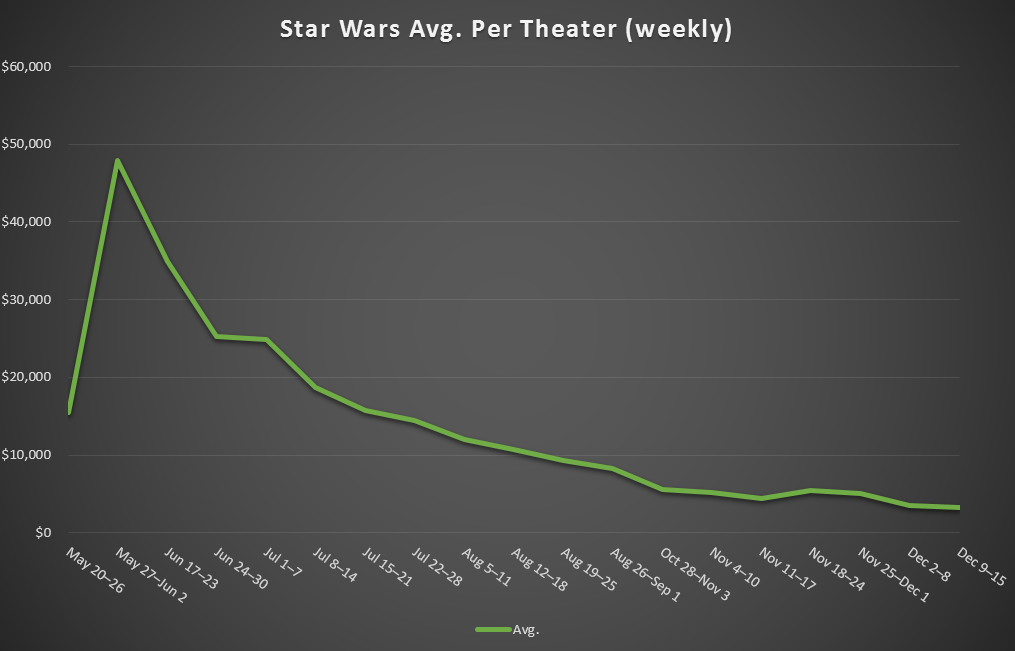
Yes, you read that correctly: Star Wars opened in 32 theaters on May 25, 1977. Evidently, a lot of those theaters didn't want to book Star Wars, fearing it would be a bomb (Sci-Fi was out of style back then). But even in those 32 theaters, Star Wars performed far above expectations. During its first week alone, it made $493,774 -- or an average of $15,430 per theater. Word of mouth about this astonishing movie spread quickly.
During its second week, when it began playing in 43 theaters, the average per theater gross was a staggering $47,968! You can bet that the executives at 20th Century Fox were pulling out all the stops to make more prints. (This was a film that was almost shut down during production by the Fox board of directors, but was saved by CEO Alan Ladd, Jr.)
Here's a chart of the average earned per theater gross using the data from Box Office Mojo: (Note: I've removed a few weekends that had missing data.)
2. The max number of theaters showing Star Wars: 1,096
Today, blockbusters open in thousands of theaters -- and usually closer to 4,000. For example, during the week of June 12-18, 2015, Jurassic World opened in 4,274 theaters. By the third week, it dropped to 3,802 theaters.
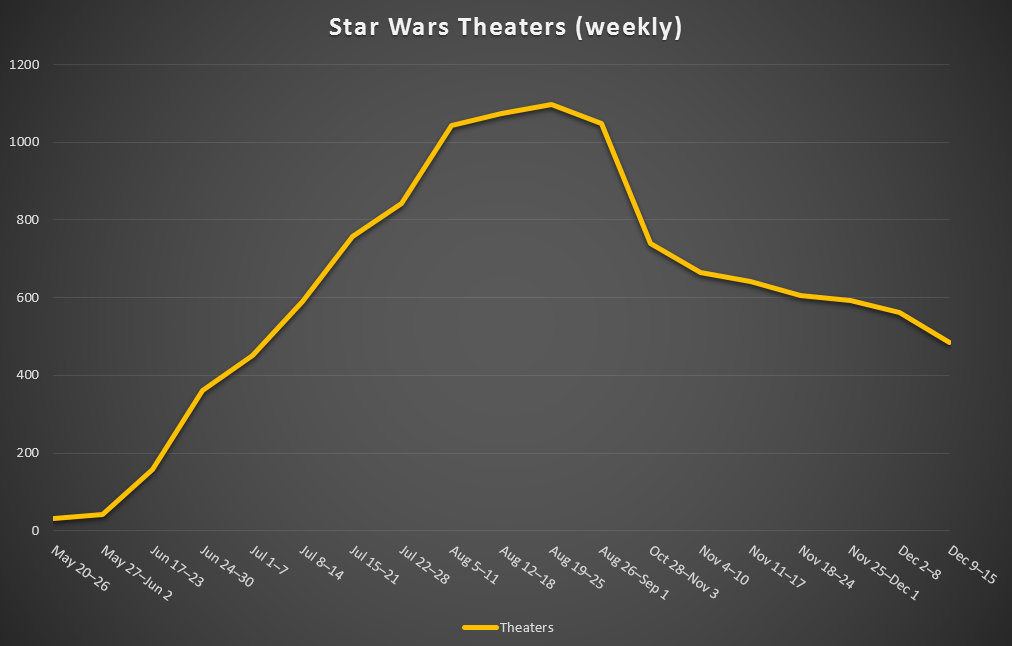
By the time I saw Star Wars (probably during the week of July 8-14, 1977), it was playing in 589 theaters and averaging $18,741 per theater.
Here's a chart that shows the number of theaters where Star Wars played in 1977. Note that the number of theaters continued to increase until nearly three months after it was released, peaking during the week August 19-25.
3. Star Wars played in theaters throughout much of 1977
Star Wars was a constant attraction in many theaters from July to December 1977. (And it played in some for a year!) Following the increase in theaters, its weekly gross continued to climb until August 5-11, 1977 ($12,473,041).
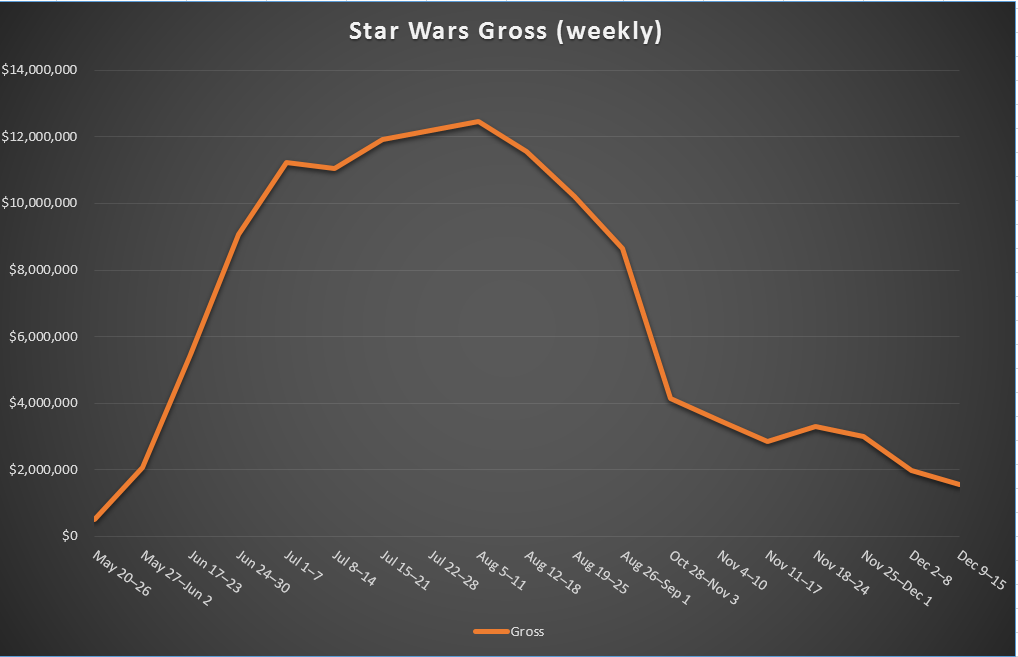
Its total gross would eventually be $194,821,449 by the end of 1977 -- and $307,263,857 during it's initial domestic release. But Star Wars still wasn't done. It would return two more times (1982 and 1997) and generate a total gross of almost $461 million.
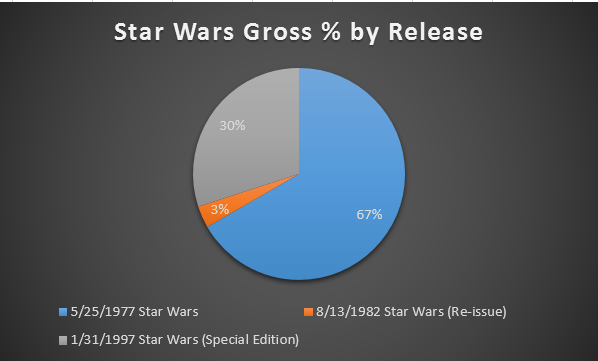
I remember when Star Wars: Special Edition came out in 1997. I tried to go, twice in fact, but it was always sold out. (I finally ended up going on a weeknight.) Like its first run in 1977, theaters hadn't completely anticipated the demand Star Wars would generate -- but they were certainly better prepared. Instead of 32 theater, it opened on 2,104 theaters. It was #1 at the box office for three weeks. How many films can be re-released after 20 years and claim the #1 box office position?
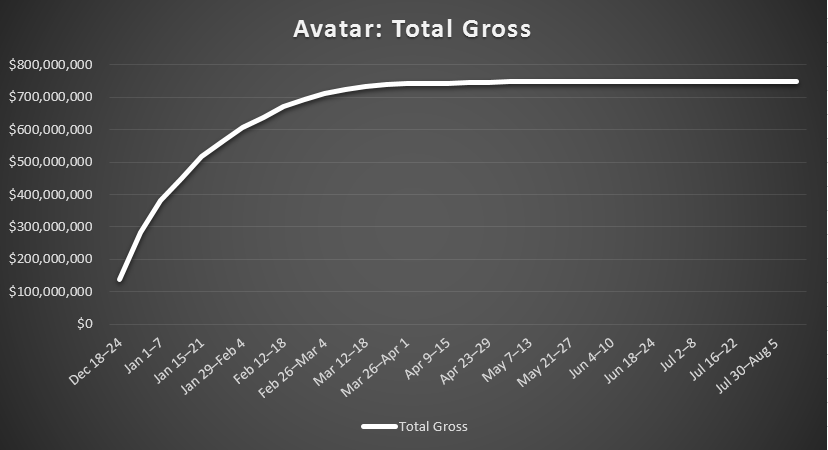
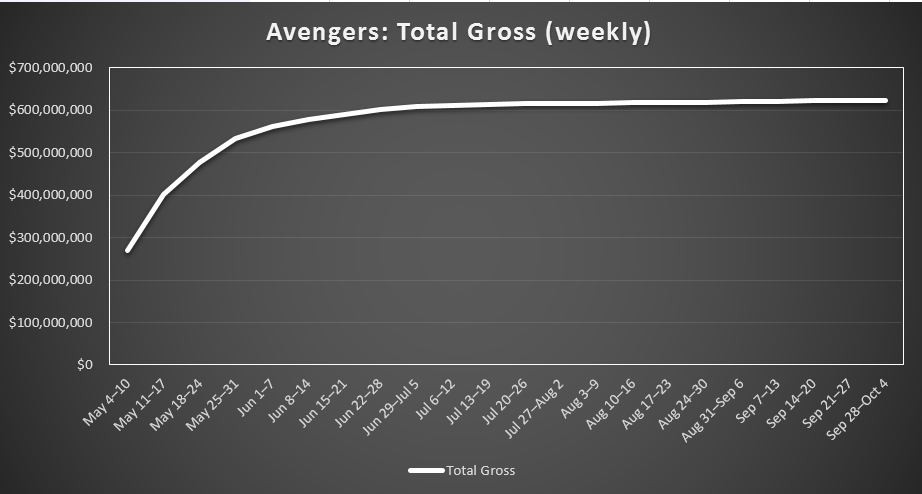
Even when you compare the total gross by week against modern blockbusters, you can see Star Wars' unique trajectory. It made its money over a long period of time, and continued to grow even months after its release.
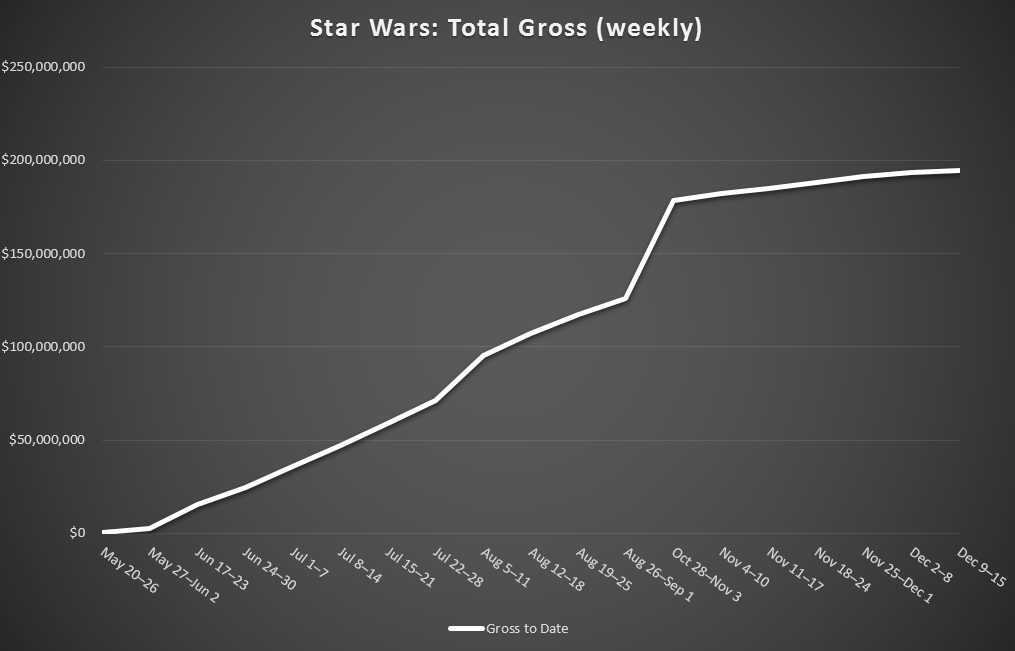
Even if modern blockbusters stay in theaters for months, they make most of their money in the first four weeks.
Here's the total domestic gross for James Cameron's Avatar (2009):
And here's Marvel's The Avengers (2012):
4. Star Wars has sold more tickets than other current blockbusters
In this list of top-grossing movies, sorted by estimated tickets, you can see how Star Wars stacks up, selling an estimated 178 million tickets -- second only to Gone with the Wind (202 million).
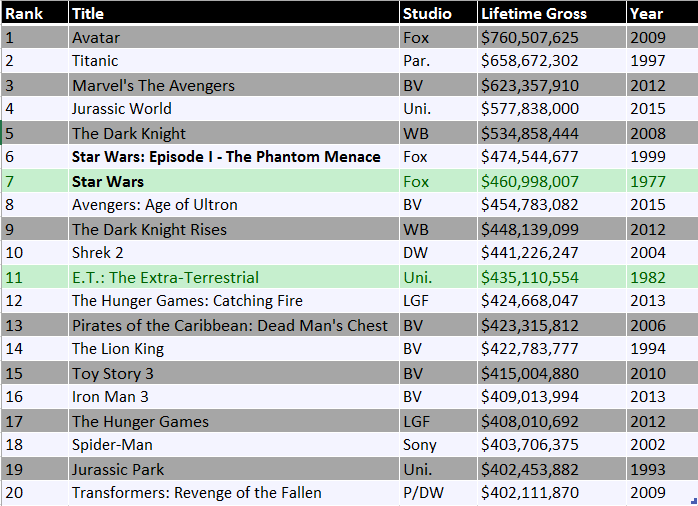
- Rows that are highlighted green are movies released after 1990.
- Rows that are bolded are films George Lucas produced, wrote, or directed.
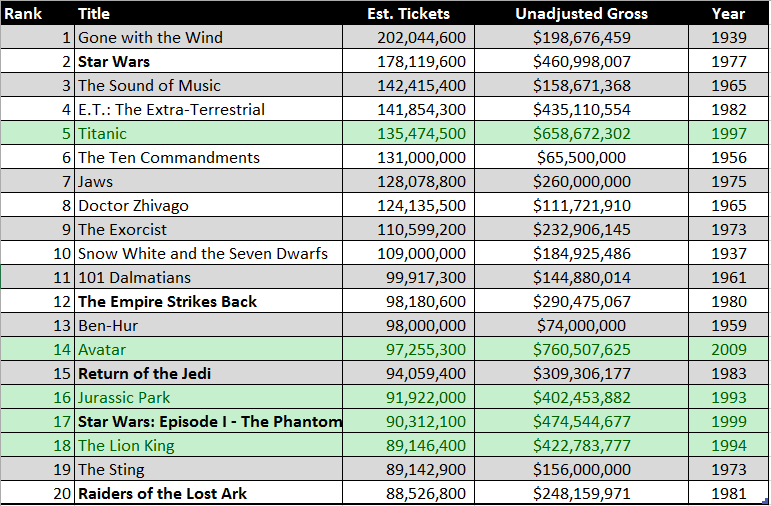
Using ticket sales and factoring in current ticket prices, Star Wars' domestic gross today would be $1.4 billion instead of $460 million.
Here's the same chart using each film's actual lifetime gross:
5. Stephen Spielberg made an estimated $40 million from Star Wars
This is one I actually didn't know until recently. The story goes that George Lucas and Steven Spielberg were vacationing in Hawaii in 1977 before the release of their films. Spielberg told Lucas that he thought Star Wars would be more successful than Close Encounters, but Lucas didn't agree. So they bet on it, giving each other 2.5% of each other's films. This article estimates that Spielberg could have made as much as $40 million from this bet.
Of course, Lucas made some money, too, since Close Encounters would go on to gross $303 million worldwide.
What does it all mean?
Star Wars (and Jaws before it) created the modern blockbuster. Before this time, films just didn't make this level of money. It's astonishing to think that a film that played on only around 1000 screens could generate $307 million in its initial release. But Star Wars was an event -- not just a movie. Think about how all the modern blockbusters are sold as "events" -- even before they've become events (thinking of The Lone Ranger and John Carter here). But instead of costing $11 million, like Star Wars, they cost the studios hundreds of millions of dollars.
Star Wars also set the template for the type of movies being sold as blockbusters. These typically fall into the Action, Sci-Fi, or Fantasy genre and are loaded with special effects. Star Wars also set up the idea of a "franchise." Hollywood has always loved sequels, but today it seems like there's more of an emphasis on sequels, prequels, spin-offs, and reboots. There's much less risk producing something that's already been successful.
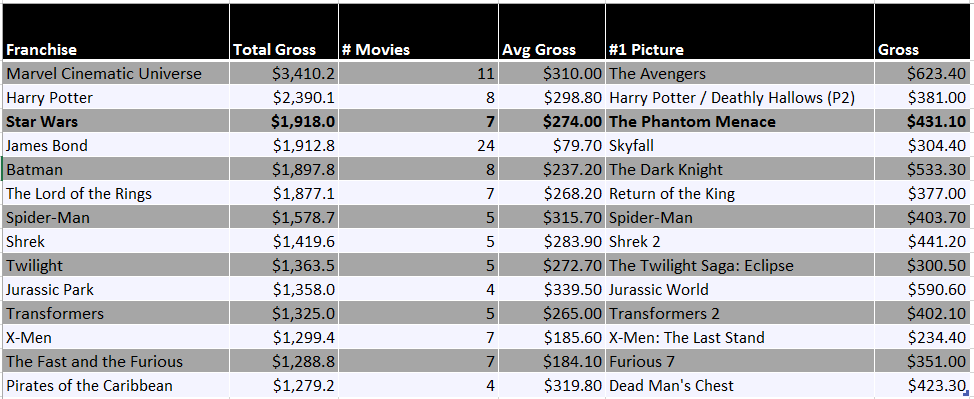
Here are some of the top franchises:
Even though Star Wars helped to create the modern blockbuster template, a lot has changed in the film business.
First, it's clear that there's much more competition for entertainment revenue today. As a result, fewer people are going to the movies than in 1977. According to a Wall Street Journal article (March 2014), "The number of tickets sold fell nearly 11% between 2004 and 2013, according to the report, while box office revenue increased 17%." More people are happy to stay home and watch YouTube, play Xbox, or watch a movie on their home theater system. The rise in revenue is coming from increased ticket prices and premium experiences like 3D and IMAX (or the premium-premium 3D/IMAX). It's estimated that 3D/IMAX accounted for 25-40% of Avatar's total gross, and 80% of its domestic gross came from 3D and/or IMAX.
Second, the international percentage of a film's gross has become much more important. Star Wars made 40.5% of its profits from international audiences in 1977. As a comparison, modern blockbusters get 59%-77% of their gross from international audiences.
In the end, films are first and foremost a business. What Star Wars showed was that a successful film could balance story, art, entertainment, innovation, and commerce. We can only hope that Star Wars: Episode VII will continue this tradition.
Labels: influences and inspirations, Star Wars


