AndyO Blog

Sunday, July 12, 2015

The Summer of Star Wars: Part II - By the Numbers

Today, we're used to hearing about movies that gross $200 million on their opening weekend. But in 1977, things were a little different.

Here are a few facts about Star Wars that might surprise you (data from Box Office Mojo).

1. Star Wars opened in only 32 theaters

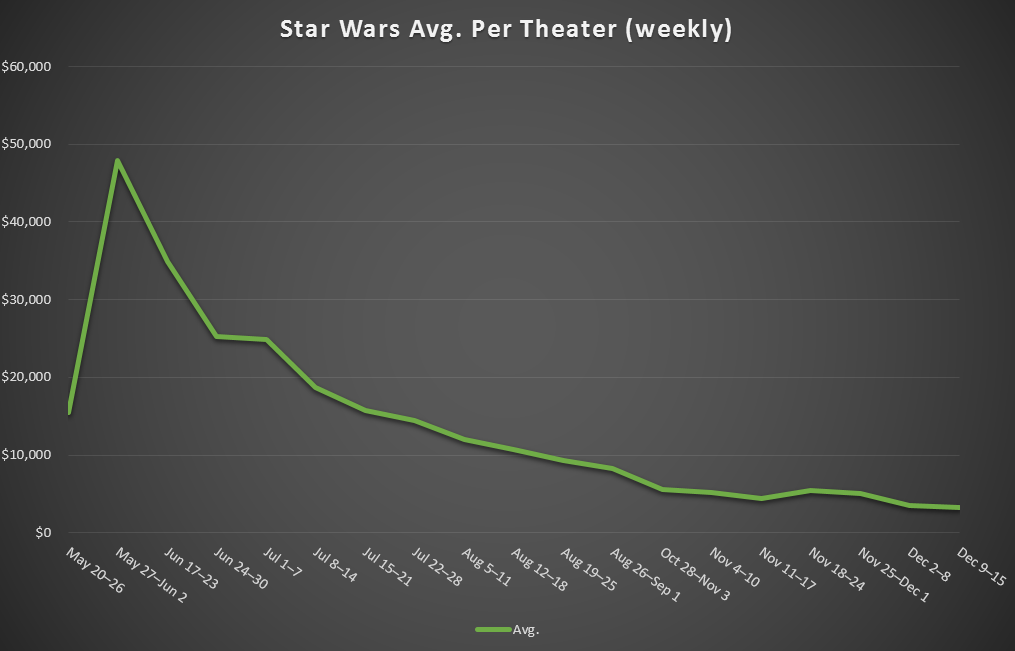
Yes, you read that correctly: Star Wars opened in 32 theaters on May 25, 1977. Evidently, a lot of those theaters didn't want to book Star Wars, fearing it would be a bomb (Sci-Fi was out of style back then). But even in those 32 theaters, Star Wars performed far above expectations. During its first week alone, it made $493,774 -- or an average of $15,430 per theater. Word of mouth about this astonishing movie spread quickly.

During its second week, when it began playing in 43 theaters, the average per theater gross was a staggering $47,968! You can bet that the executives at 20th Century Fox were pulling out all the stops to make more prints. (This was a film that was almost shut down during production by the Fox board of directors, but was saved by CEO Alan Ladd, Jr.

Here's a chart of the average earned per theater gross using the data from Box Office Mojo: (Note: I've removed a few weekends that had missing data.)
Star Wars Avg. Per Theater (Weekly) - Chart


2. The max number of theaters showing Star Wars: 1,096

Today, blockbusters open in thousands of theaters -- and usually closer to 4,000. For example, during the week of June 12-18, 2015, Jurassic World opened in 4,274 theaters. By the third week, it dropped to 3,802 theaters.

By the time I saw Star Wars (probably during the week of July 8-14, 1977), it was playing in 589 theaters and averaging $18,741 per theater.

Here's a chart that shows the number of theaters where Star Wars played in 1977. Note that the number of theaters continued to increase until nearly three months after it was released, peaking during the week August 19-25.
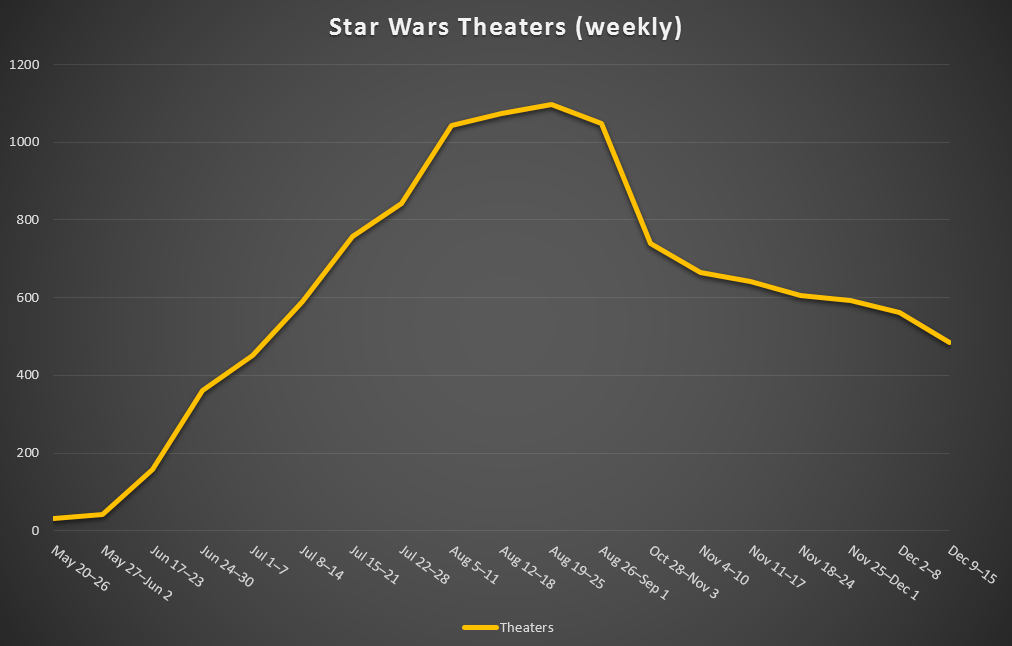
Chart: Star Wars Theater Count (weekly)


3. Star Wars played in theaters throughout much of 1977

Star Wars was a constant attraction in many theaters from July to December 1977. (And it played in some for a year!) Following the increase in theaters, its weekly gross continued to climb until August 5-11, 1977 ($12,473,041).
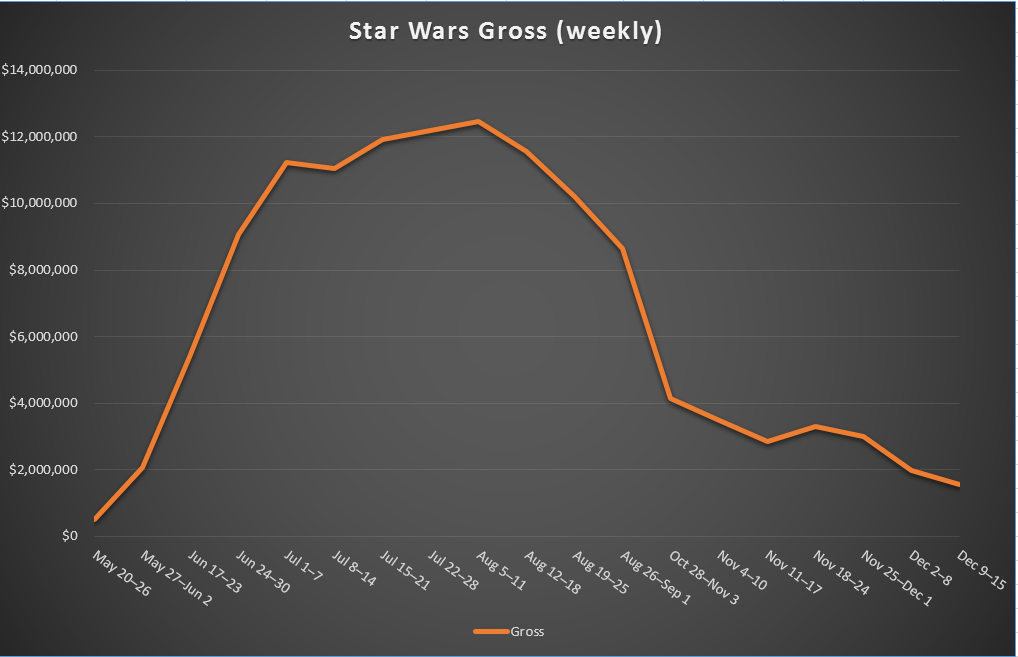
Chart: Star Wars Gross (weekly)

Its total gross would eventually be $194,821,449 by the end of 1977 -- and $307,263,857 during it's initial domestic release. But Star Wars still wasn't done. It would return two more times (1982 and 1997) and generate a total gross of almost $461 million.
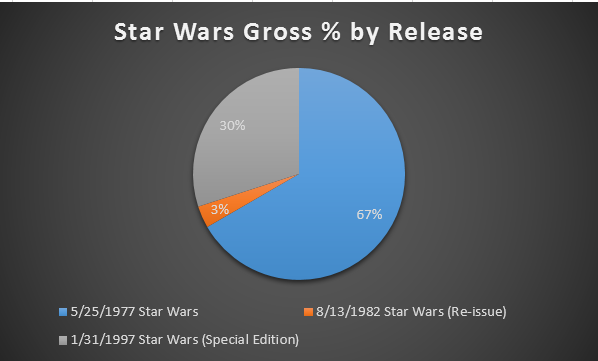
Chart: Star Wars Gross % by Release

I remember when Star Wars: Special Edition came out in 1997. I tried to go, twice in fact, but it was always sold out. (I finally ended up going on a weeknight.) Like its first run in 1977, theaters hadn't completely anticipated the demand Star Wars would generate -- but they were certainly better prepared. Instead of 32 theater, it opened on 2,104 theaters. It was #1 at the box office for three weeks. How many films can be re-released after 20 years and claim the #1 box office position?  

Even when you compare the total gross by week against modern blockbusters, you can see Star Wars' unique trajectory. It made its money over a long period of time, and continued to grow even months after its release.
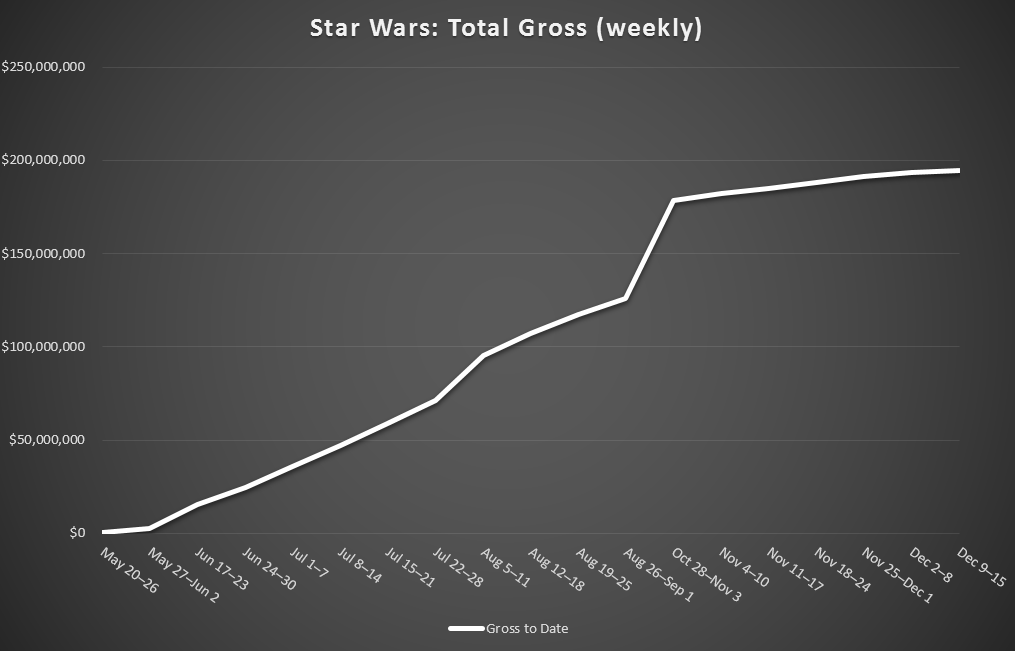
Chart: Star Wars Total Gross (weekly)

Even if modern blockbusters stay in theaters for months, they make most of their money in the first four weeks.

Here's the total domestic gross for James Cameron's Avatar (2009):
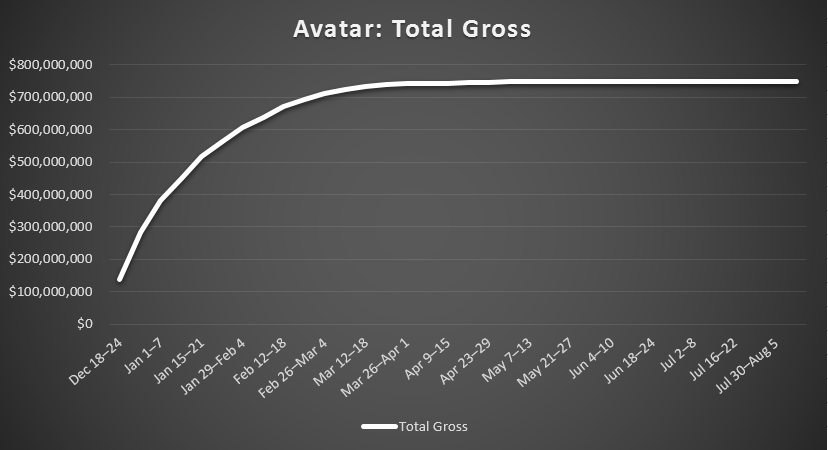
Chart: Avatar Total Gross (weekly)

And here's Marvel's The Avengers (2012):
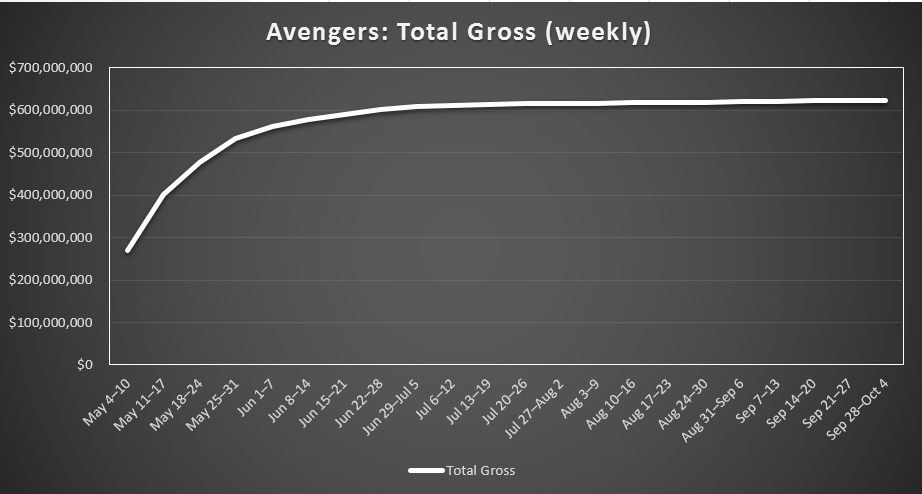
Chart: The Avengers Total Gross (weekly)


4. Star Wars has sold more tickets than other current blockbusters

In this list of top-grossing movies, sorted by estimated tickets, you can see how Star Wars stacks up, selling an estimated 178 million tickets -- second only to Gone with the Wind (202 million).

  • Rows that are highlighted green are movies released after 1990.
  • Rows that are bolded are films George Lucas produced, wrote, or directed.
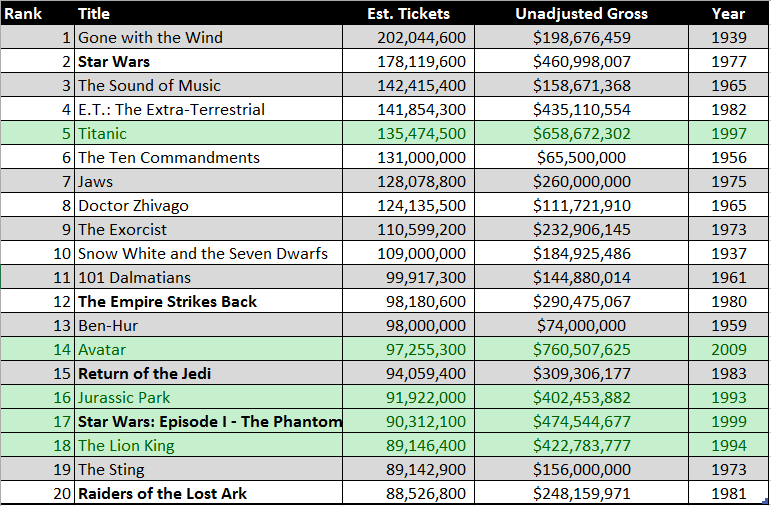
Chart: Top movies by ticket sales

Using ticket sales and factoring in current ticket prices, Star Wars' domestic gross today would be $1.4 billion instead of $460 million.

Here's the same chart using each film's actual lifetime gross:
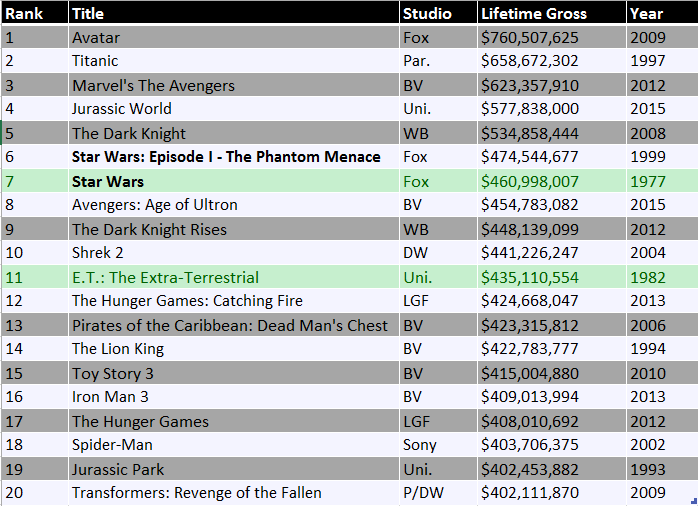
Chart: Top movies by actual lifetime gross


5. Stephen Spielberg made an estimated $40 million from Star Wars

This is one I actually didn't know until recently. The story goes that George Lucas and Steven Spielberg were vacationing in Hawaii in 1977 before the release of their films. Spielberg told Lucas that he thought Star Wars would be more successful than Close Encounters, but Lucas didn't agree. So they bet on it, giving each other 2.5% of each other's films. This article estimates that Spielberg could have made as much as $40 million from this bet.

Of course, Lucas made some money, too, since Close Encounters would go on to gross $303 million worldwide. 


What does it all mean?

Star Wars (and Jaws before it) created the modern blockbuster. Before this time, films just didn't make this level of money. It's astonishing to think that a film that played on only around 1000 screens could generate $307 million in its initial release. But Star Wars was an event -- not just a movie. Think about how all the modern blockbusters are sold as "events" -- even before they've become events (thinking of The Lone Ranger and John Carter here). But instead of costing $11 million, like Star Wars, they cost the studios hundreds of millions of dollars.

Star Wars also set the template for the type of movies being sold as blockbusters. These typically fall into the Action, Sci-Fi, or Fantasy genre and are loaded with special effects. Star Wars also set up the idea of a "franchise." Hollywood has always loved sequels, but today it seems like there's more of an emphasis on sequels, prequels, spin-offs, and reboots. There's much less risk producing something that's already been successful.

Here are some of the top franchises:
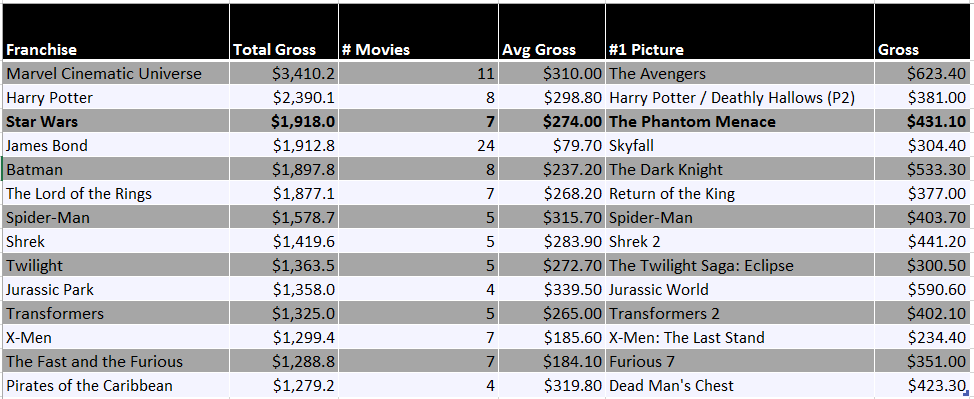
Chart: Top movie franchises by total gross

Even though Star Wars helped to create the modern blockbuster template, a lot has changed in the film business. 

First, it's clear that there's much more competition for entertainment revenue today. As a result, fewer people are going to the movies than in 1977. According to a Wall Street Journal article (March 2014), "The number of tickets sold fell nearly 11% between 2004 and 2013, according to the report, while box office revenue increased 17%." More people are happy to stay home and watch YouTube, play Xbox, or watch a movie on their home theater system. The rise in revenue is coming from increased ticket prices and premium experiences like 3D and IMAX (or the premium-premium 3D/IMAX). It's estimated that 3D/IMAX accounted for 25-40% of Avatar's total gross, and 80% of its domestic gross came from 3D and/or IMAX.

Second, the international percentage of a film's gross has become much more important. Star Wars made 40.5% of its profits from international audiences in 1977. As a comparison, modern blockbusters get 59%-77% of their gross from international audiences. 

In the end, films are first and foremost a business. What Star Wars showed was that a successful film could balance story, art, entertainment, innovation, and commerce. We can only hope that Star Wars: Episode VII will continue this tradition.

Labels: ,

posted by AndyO @ 5:58 PM   0 comments

Friday, July 10, 2015

The Summer of Star Wars: Part I

A long time ago, in 1977... information didn't move as fast as it does today. And even when you did hear about something noteworthy, like a groundbreaking summer film, it was usually through word of mouth. That's how I found out about Star Wars.

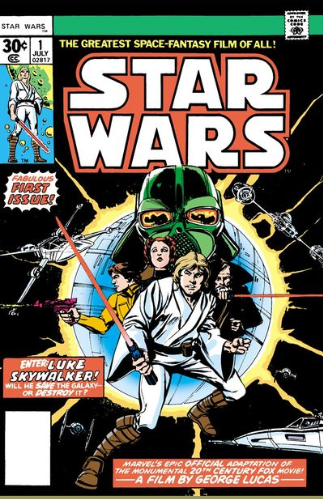
I was attending a summer camp as a 10-year-old when I heard the other kids talking about Star Wars. No one had actually seen it yet. The reason was that it still hadn't made it to our local cinema in Richland, Washington. Instead, boys arrived at camp with the Marvel comic adaptations of Star Wars.     

image

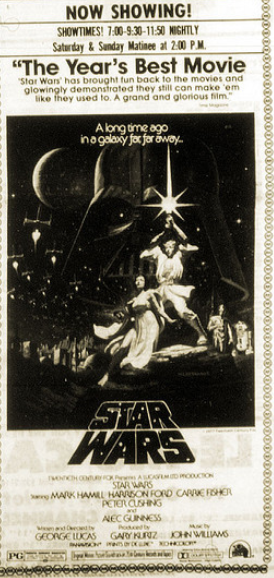
Once Star Wars finally did make it to our local theater (I'm guessing by late June or July), I opened the Tri-City Herald and stared at the black-and-white advertisement that probably looked something like this:

image

Similar to the comics, the images in that low-fidelity advertisement seemed to evoke more mysteries and questions. Was that guy holding a laser sword? What was that menacing mask floating in the background? Why were those ships flying toward that small moon? Or is it a space station? (Little did I know Han Solo would make the same mistake.)

Seeing Star Wars

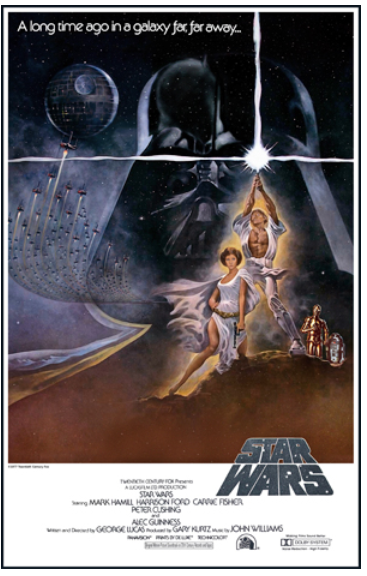
Eventually, I did see Star Wars with my family at the Uptown Theater in downtown Richland. The Uptown was built in 1950s, and like most of the theaters from that era, it featured a single massive screen. We stood in line for a while, and as we inched toward the box office I gazed upon the full-color poster. It was most likely the Tom Jung version: 

image

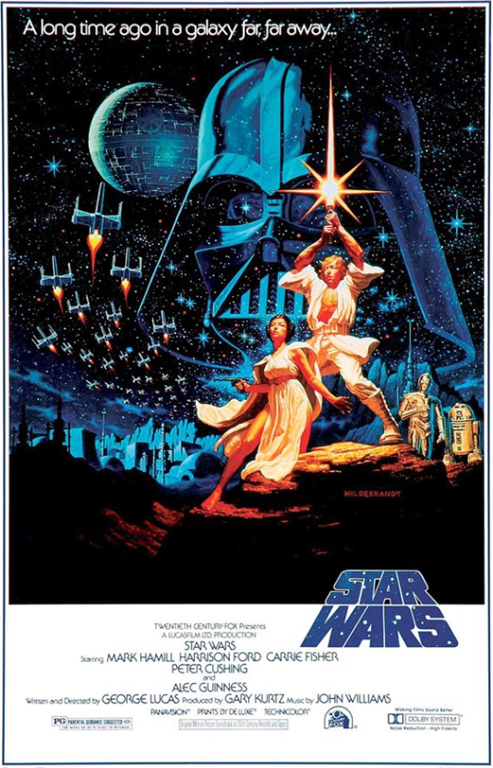
But it could have been the Brothers Hildebrandt poster:

image

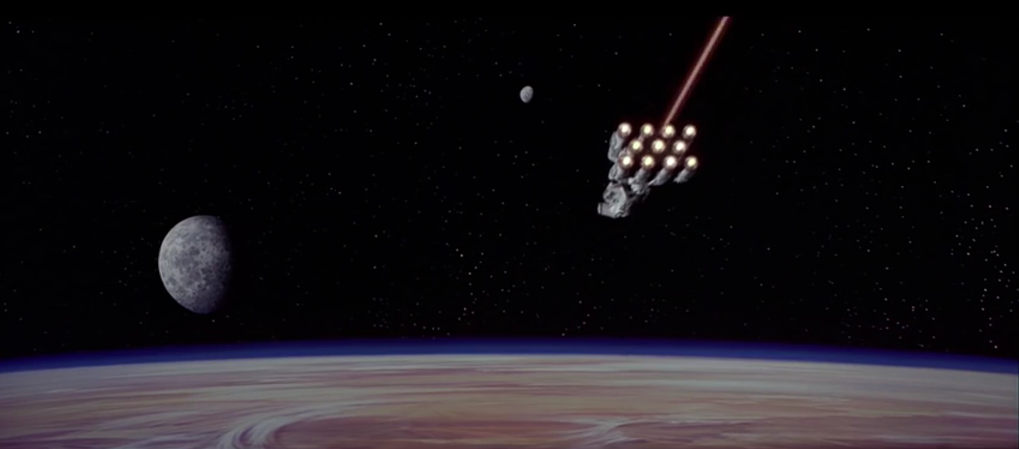
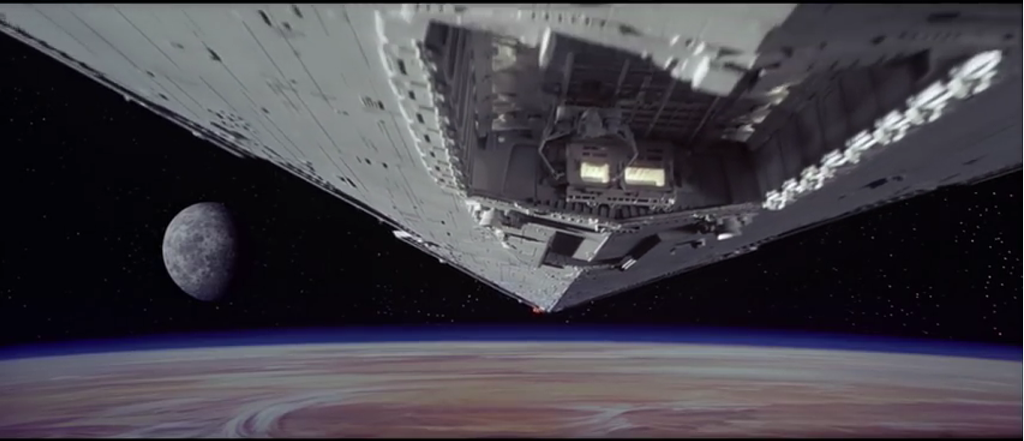
After buying a tub of buttered popcorn, we settled into our seats in the sold-out auditorium. But once the movie started, I probably stopped eating my popcorn. The image of that starship whizzing by (which I later learned was the Rebel Blockade Runner) and then the colossal Star Destroyer giving chase, must have made my little jaw drop. (Later I'd learn that even the people who worked on Star Wars were awestruck by that opening scene; they had no idea it was going to look like that.) 

image

image

As spectacular as the opening was, I also remember being a bit perplexed: Were the Stormtroopers robots? Was Darth Vader a robot? But I soon forgot about my questions; there was just too much to see and hear.

Imagine you're a 10-year-old kid who had never seen Star Wars -- and you're presented with a fantastic world that includes:

  • Jawas (robots or creatures?) driving their giant Sandcrawler vehicle across the sand
  • Luke driving his Landspeeder that floated above the ground
  • The fearsome Sandpeople who almost kill Luke (I jumped when they blocked Luke's electrobinoculars and were suddenly hovering over him)
  • Luke getting his father's Lightsaber from Ben "Obi-Wan" Kenobi, and then hearing about the "Clone Wars" and the death of his father at the hands of Darth Vader (I don't even remember if I knew the guy at the beginning who throttled Captain Antilles was Darth Vader).
  • The Mos Eisley Cantina: Hammerhead carrying on a casual conversation (I remember my Mom nudging me as if she couldn't believe it either); Obi-Wan slicing some guy's arm off who was bothering Luke a the bar ("He doesn't like you! I don't like you either!"); and Han Solo shooting Greedo under the table (later re-edited by Lucas for the special edition with Greedo shooting first.)
  • The Death Star destroying an entire planet with its laser weapon
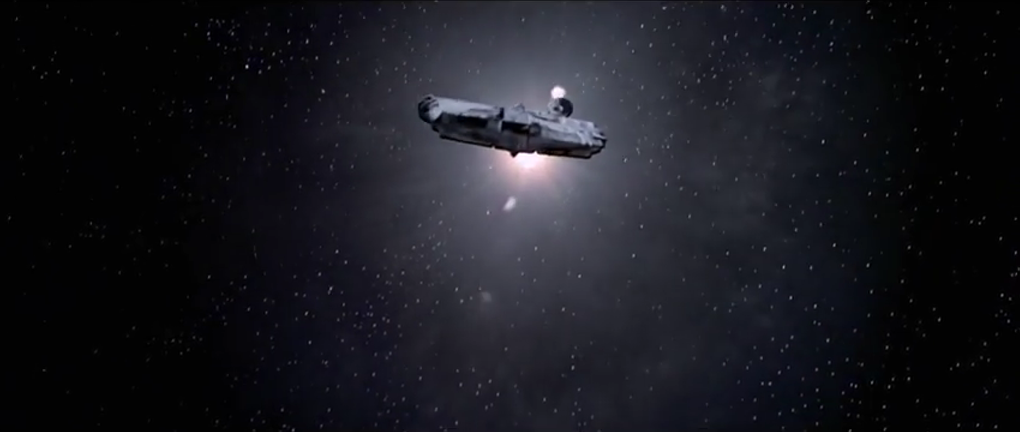
  • The Millennium Falcon jumping to hyperspace
  • Luke practicing with his Lightsaber for the first time -- and using the Force
  • R2-D2 playing a holographic chess game against Chewbacca. (C3PO: "Let the Wookie win!")
  • Luke, Han, and Chewie running around the Death Star, and Obi-Wan attending to the business of turning off the tractor beam.
  • The rescue of sassy Princess Leia and the gunfight in the detention block
  • Luke getting pulled under the murky water in the trash compactor by a one-eyed creature -- and then escaping
  • Luke, Han, Leia, and Chewie almost getting crushed in the trash compactor, and the Droids saving the day ("Listen to them R2; they're dying!")
  • Obi-Wan dueling with Vader -- and appearing to lose. Did that Lightsaber incinerate him? Why is Vader stepping on Obi-Wan's empty cloak? (But then we hear his voice in Luke's head, "Run, Luke! Run!")
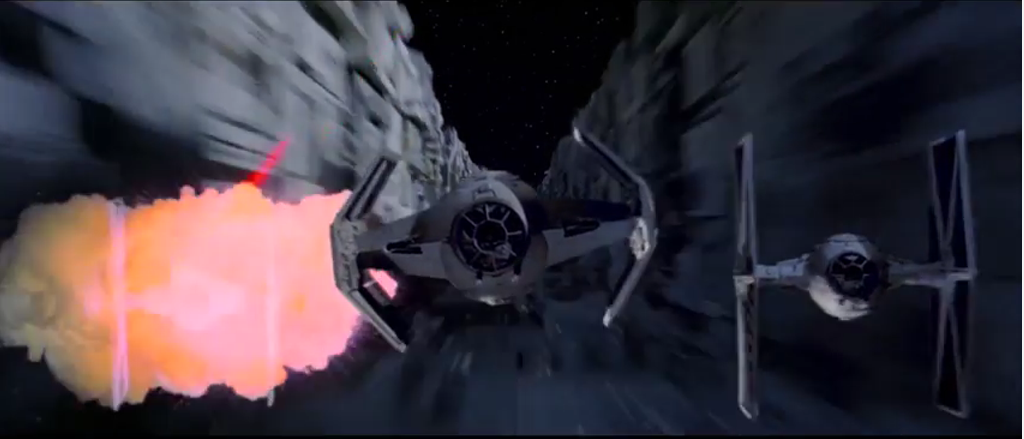
  • The escape from the Death Star and the incredible battle against the TIE fighters. After Luke blasts one of them, Solo yells his famous line: "Great, kid! Now don't get cocky!"

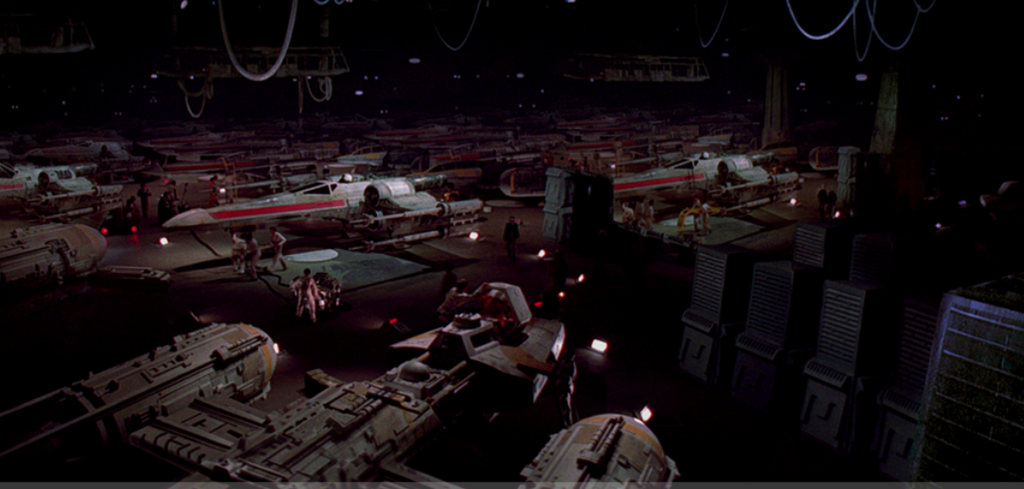
At this point, I remember thinking the movie was over. They had escaped to Yavin. What more was there to do? Then I saw those sleek X-wing fighters in the hanger, and I knew we were in for an even bigger battle. Best of all, Luke was piloting one of the ships -- and taking R2 with him!

image

As transcendent as that final act of Star Wars was, there were two scenes that put it over the top:

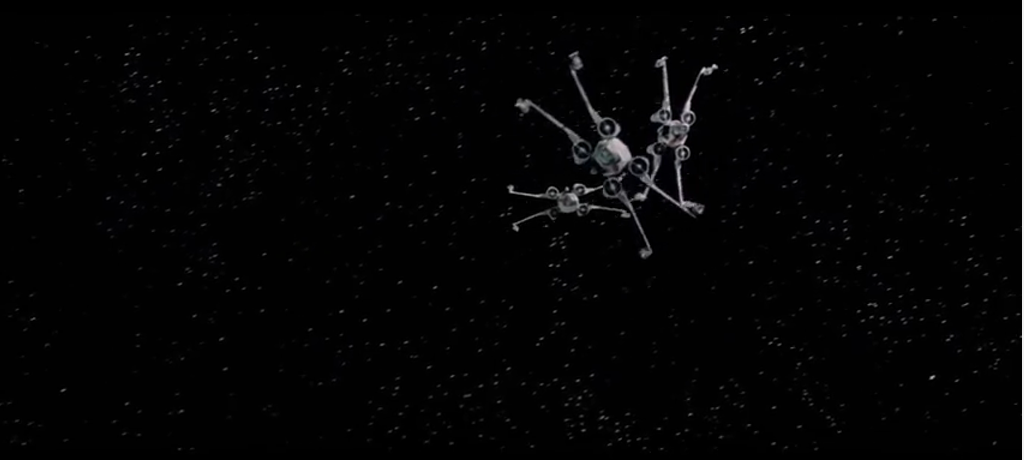
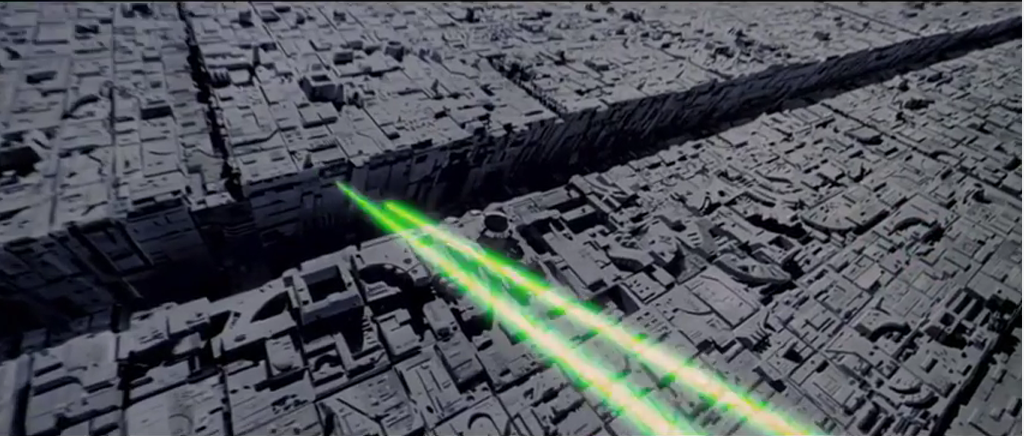
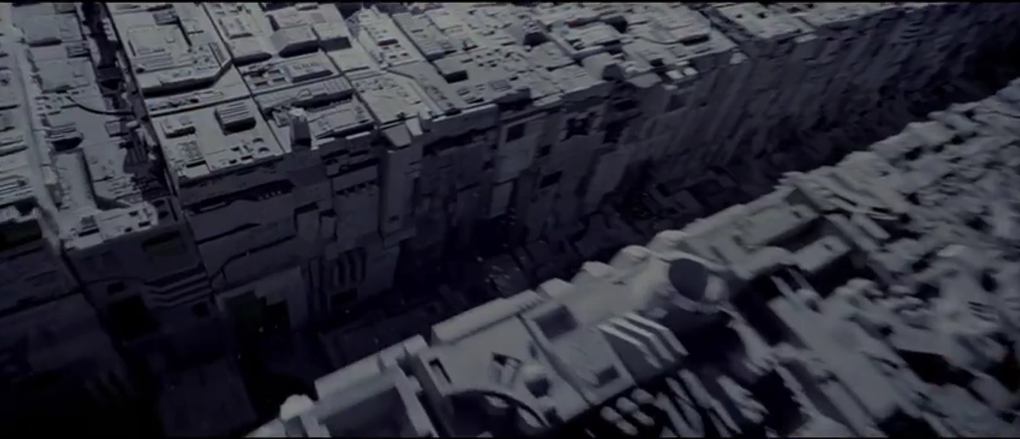
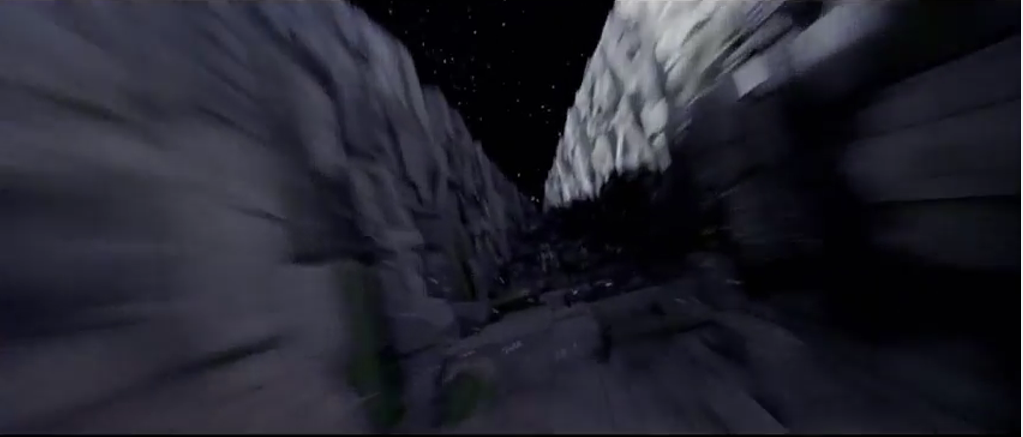
1) The point-of-view shot of the fighters flying into the Death Star trench.

image

image

image

image

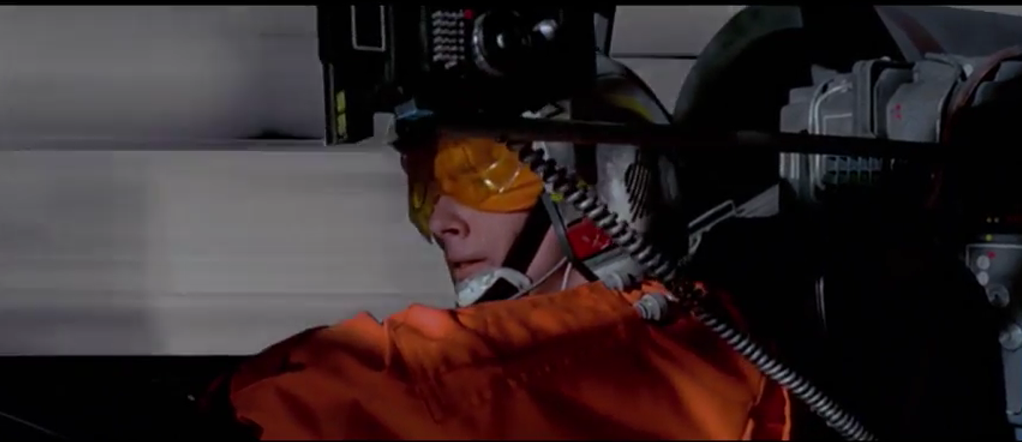
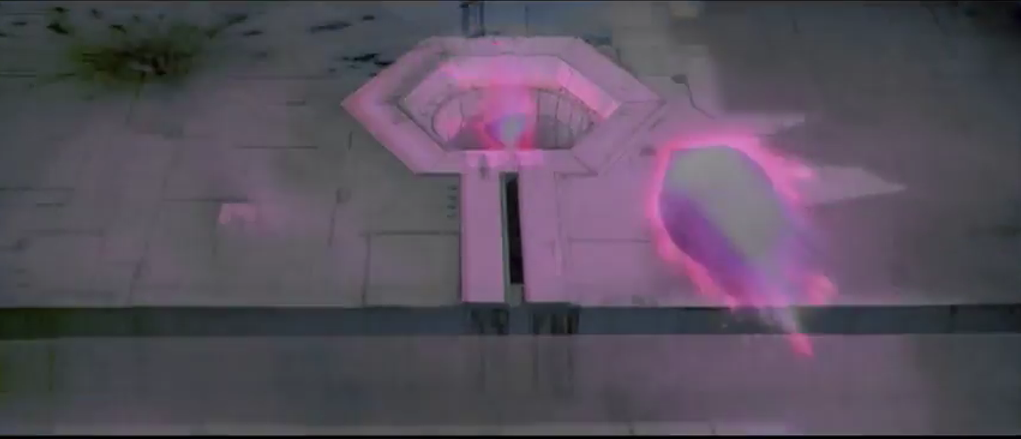
2) Luke hearing the voice of Obi-Wan telling him to "let go," turning off his targeting computer, and then destroying the Death Star (with Han Solo and Chewie's help, of course).

image

image

image

image

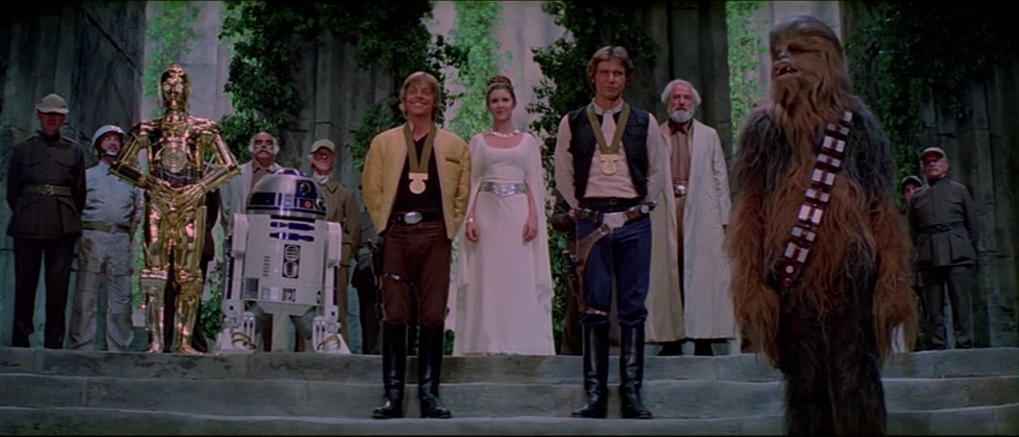
And if that wasn't enough, Luke, and Solo receive medals from the Princess. (I've never understood why Chewbacca didn't get a medal, but maybe it was against his code to receive awards?)

image

Aftermath

After the movie, we drove home through darkness and I went straight to bed. But something transformative had happened to me during Star Wars. As I fell asleep, I dreamed continuously that I was Luke in Star Wars. I relived the scene where he dove his X-wing into the Death Star trench. When I woke the next day, it seemed as if the world had changed. This wasn't just a film; it was a historic event, and I was somehow part of it.

Later, I read about other people who experienced similar reactions -- even adults. For example, Roger Ebert opened his review of Star Wars with this:

Every once in a while I have what I think of as an out-of-the-body experience at a movie. When the ESP people use a phrase like that, they're referring to the sensation of the mind actually leaving the body and spiriting itself off to China or Peoria or a galaxy far, far away. When I use the phrase, I simply mean that my imagination has forgotten it is actually present in a movie theater and thinks it's up there on the screen. In a curious sense, the events in the movie seem real, and I seem to be a part of them.

The "out-of-body experience" that Ebert describes might explain what happened to me. Usually when the movie's over and the lights come up, you wake from the cinematic dreamworld. But with Star Wars, the experience was so powerful that it continued right into my own dreams. It seemed like magic. 

Ten or so years later, when I was in college, I found out about Joseph Campbell (1904-1987), the author of The Hero with a Thousand Faces through Bill Moyers' show The Power of Myth. Campbell had fused ideas from Adolph Bastian (1826-1905) and Carl Jung (1875-1961) to arrive at "The Hero's Journey" -- the idea that all myths are constructed from similar elements. George Lucas rediscovered The Hero with a Thousand Faces during the writing of Star Wars.

"I spent about a year reading lots of fairy tales--and that's when (the Star Wars screenplay) starts to move away from Kurosawa and toward Joe Campbell," Lucas says. "About the time I was doing the third draft I read The Hero with a Thousand Faces, and I started to realize I was following those rules unconsciously. So I said, I'll make it fit more into that classic mold."

Rinzler, J. W. (2013-10-22). The Making of Star Wars (Enhanced Edition) (Kindle Locations 1655-1657). LucasBooks. Kindle Edition.

We all have these transcendent experiences in our lives, but for me Star Wars was one that stayed with me. It was the first time a piece of art had reached me on such a deep level. When I finally discovered the keys to how Star Wars had cast its spell, I was surprised that it didn't diminish my view of it as a film. If anything, the more I learned about how this little $11 million film was made, the more interesting it became. To this day, I still buy books about the making of Star Wars, and I'm still surprised by how much creativity is went into it.   

Labels:

posted by AndyO @ 9:33 PM   0 comments

Monday, April 15, 2013

Leaving the cave with Kevin J. Anderson

It was a bright Easter Sunday, and I was sitting across from author Kevin J. Anderson at Elliott Bay Brewing Company in Burien, Washington. We were eating burgers, drinking beer, and talking about the world.

Kevin was in town on a book tour for his latest novel, Hellhole Awakening, which he'd co-written with Brian Herbert. We'd actually met for the first time on Friday at the book signing, which was held (of all places) in a church. (Kevin made the observation that we were in a church on Good Friday talking about a novel called Hellhole.)

After the signing, Kevin had stayed over the weekend as a speaker for Norwescon, the largest Northwest Sci-Fi convention. Since I knew he was in Seattle for a few days, I'd invited him to lunch.

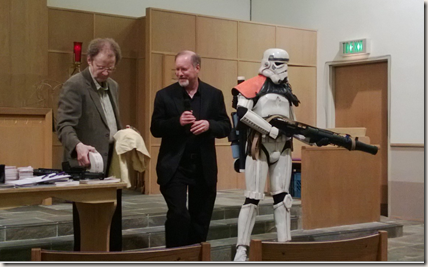
Brian Herbert, Kevin J. Anderson, and Sandtrooper

As we drove to lunch (before I got us lost -- another story), Kevin talked about how he'd just finished a panel discussion called "Reasons to Leave Your Cave." He explained how writers, typically more comfortable with solitude, needed to push themselves to get out and meet people. Going out on a book tour, like he was for Hellhole Awakening, was how you connected with your audience and created awareness for your books. (Even for a New York Times bestselling author like Kevin.)

As a writer and introvert, I knew what Kevin was talking about. I had to push myself out of my cave on a daily basis. Our lunch was a great example.


The Paths of Two Rush Fans

Though we were meeting in person for the first time, I'd known Kevin's writing for many years. He first came to my attention with a spooky short story he wrote with Neil Peart (the drummer for Rush) called "Drumbeats" (part of the short story collection Shock Rock II). That story, about a drummer touring Africa by bicycle who finds a very unique drum, had always stayed with me. The writing was cinematic, and like a lot of great stories it got better with each reading.

A few years later, I saw Kevin's books show up in Neil Peart's Bubba's Book Club reviews, including Issue 3 (Scattered Suns (The Saga of Seven Suns, Book 4) and Issue 9 (Metal Swarm (The Saga of Seven Suns - Book 6). Here's an excerpt of what Neil wrote about Kevin in Issue 3 (from 2005):

Full Disclosure: Kevin J. Anderson has been a friend of mine for about 20 years, and I have recently written an introduction for a forthcoming book of his stories [Landscapes]. A few years back we even collaborated on a short story called "Drumbeats" -- though Kevin did all the work; I just supplied some African background and French dialogue.

Having stated that, I truly believe Kevin is a great writer. ...

Kevin Anderson sent me his first published novel, Resurrection Inc., in the late '80s, and I was extremely impressed -- it was so original, so imaginative, so profound, and at the same time so true to life.

Around the time I read "Drumbeats," I'd actually been trying my hand at creative writing (screenplays, short stories, novels). But after years of rejection letters, I found another path as a technical writer at Microsoft in 1996, where I've been ever since.

Being around all those technical people at Microsoft helped sharpen my technical skills. But it was other writers there, namely my friends Cheryl Lowry and Charlie Montgomery, who helped demystify the web publishing process. And so my Neil Peart fansite launched in 2004.

At first, it was a one-way platform where I shared my appreciation of Neil's work (for example: Best Beats). Then people started sending me email, telling me how they appreciated the site. (Some thought I actually worked for Neil.)

What had started out as was a virtual thank you card to Neil Peart and Rush had actually been a beacon to other Rush webmasters, fans, musicians, and (of course) drummers. And like my lunch with Kevin, I would sometimes meet some of these people in person.

In many ways, this website helped get me out of my cave and into the real world.

Clockwork Angels

Early in 2012, Kevin announced that he was working on a novelization of Rush's forthcoming album, Clockwork Angels. For Rush fans, this novel would turn out to be an unexpected gift -- a bonus companion volume to one of Rush's best albums in their long career.  

For this reader (or listener, since I actually listened to the audiobook version read by Neil Peart), I was struck again by Kevin's visual prose. Here's a great passage:

The clanging bell and hiss of steam grew louder as he raced to the tracks. Upon landing on the glowing rails, the train transformed into a narrow stampede of mammoths, a long line of heavy cargo boxes and passenger gondolas lit with phosphorescent running lights, balanced by graceful balloon sacks. A geyser of exhaust bubbled out of the lead engine like the breath of a sleeping white dragon. Steel wheels rolled along the metal lines, and the engines huffed. 

(The Rush fan will notice how Kevin sneaks in a Rush reference from the song "Countdown." I loved finding those "Easter Eggs" throughout Clockwork Angels: The Novel.)

During our lunch (and at his booksigning), it was clear that Kevin was a big Rush fan. Like many of us, Rush inspires Kevin. As he wrote in the press release for Clockwork Angels: The Novel, "You can find Rush references sprinkled through many of my Dune novels, the Saga of Seven Suns, my Terra Incognita trilogy. Probably more than even I can identify, because the music is so intertwined in my imagination."

Which is what made this a dream project for him.

As he told me over lunch, he and Neil had wanted to collaborate on a larger project for years, but the right idea and timing hadn't come together. Then during a lunch that Kevin and his wife Rebecca had with Neil in Santa Monica, Neil was talking excitedly about a new album he was working, Clockwork Angels. He said excitedly, "Someday there'll be a Broadway Musical, and a Novel -- even Ice Follies!"

Rebecca said, "Novel? Who's going to write the novel?"

Neil answered: "Well, Kevin is of course!"

Back at our lunch, I told Kevin that I really enjoyed how he'd expanded the story from the lyrics. He told me that Neil had actually worked out many of the details behind the lyrics himself. When Neil was between Red Rocks shows on the "Time Machine Tour, he and Kevin brainstormed much of the story during a hike up Mt. Evans (one of Colorado's 14,000 foot peaks). Then it was up to Kevin to write. He said he wrote the book very fast, but that's how he always writes. (This is a writer who releases multiple books a year, after all.)

During the writing process, there was a feedback loop between Kevin, Neil, and artist Hugh Syme, as they traded work back and forth. The result, if you haven't seen it, is a beautiful, full-color book that spent two weeks on the New York Times Best Sellers list.

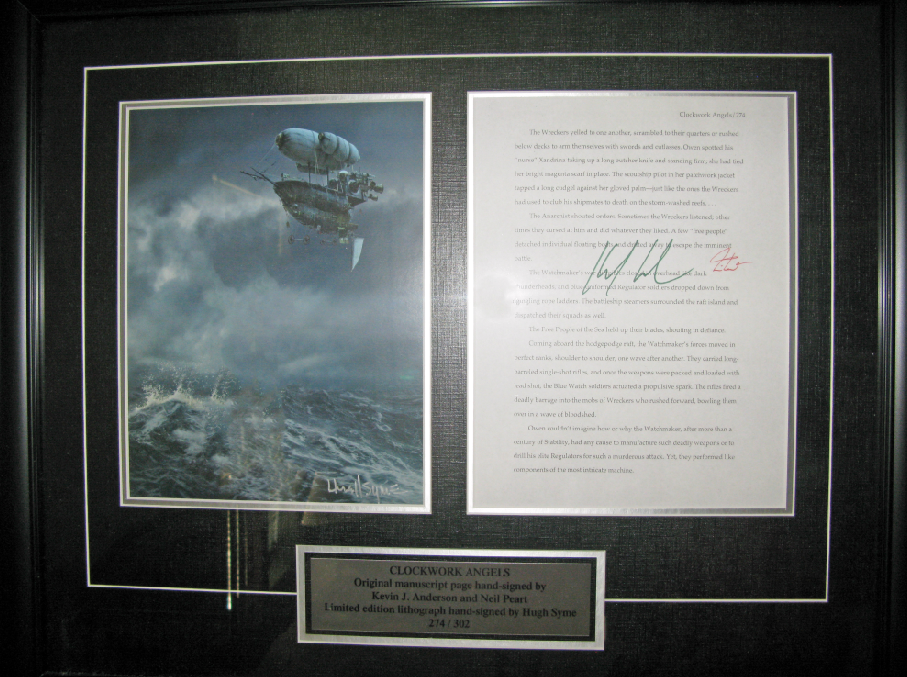
Since I'm a big Rush fan, I ended up buying the Gold Edition (#274), which included a framed original manuscript page and Hugh Syme lithograph (all signed). Kevin told me when they put these on sale, the demand for the Gold and Silver editions was so high it brought down the Rush server!

image

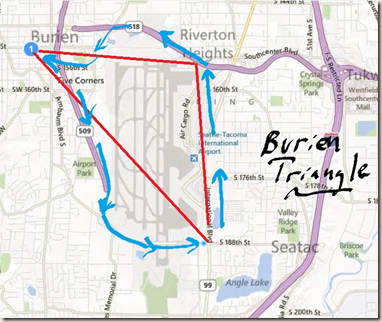
Lost in the Burien Triangle 

On the drive back from Burien to Kevin's hotel in Sea-Tac, I got us lost for the second time that day (yes, a second time). As we got back on course (thanks to Kevin's iPhone), Kevin looked out the window at the massive apparition rising to the south and asked if it was Mt. Rainier. I said it was.

I knew Kevin was an avid climber (having scaled all 54 of the 14,000 foot "Fourteeners" in Colorado). I asked if he'd ever climbed Rainier. He said he wanted to, but never had. He talked about how it's much easier to climb to 14,000 feet when you start from 5,000 feet (instead of from sea level, like Rainier).

I pulled up to the Doubletree hotel, and we shook hands. Then Kevin was off to work on his latest book, and I was off to my Mom's 70th birthday party at another restaurant. As I drove on, I started beating myself up for getting lost. Kevin was totally easygoing about it, but it was embarrassing for me. In the end, I had to concede that driving around Burien was like driving in a foreign city (especially when your phone navigation fails).

As I approached the exit for I-5 North, I saw a message on one of the traffic signs: "5-MILE BACKUP. EXPECT DELAYS!" I decided to drive home the long way, on I-405 around Lake Washington, and then across the 520 floating bridge.

It would take longer, but at least I knew where I was going.

-------------------

To commemorate my adventures with Kevin, I hereby name this area of Seattle The Burien Triangle. Consider yourself warned...

image_thumb

Read more about Kevin J. Anderson at his website, Wordfire.com.

Read about how Resurrection, Inc., was inspired by Rush's "Grace Under Pressure.

Listen to Kevin J. Anderson talk about Clockwork Angels.

Labels: , ,

posted by AndyO @ 12:25 PM   0 comments

Thursday, April 04, 2013

Roger Ebert and me (updated)

Today I heard the sad news that Roger Ebert passed away at age 70. Ebert is one of my favorite writers, and his voice will be missed. Here's Ebert's final work, "A Leave of Presence."

As my own tribute, I'm also reposting my blog from June 12, 2011, "Roger Ebert and me":

------------------

Originally posted on June 12, 2011

I've always been a fan of Roger Ebert's writing. I still remember the day in the 1990s when I was browsing his movie review book in The University Bookstore in Seattle, and I read his review of Peter Greenaway's The Cook, the Thief, his Wife, and her Lover. I had absolutely hated the movie; it had almost made me physically ill. But then I read Ebert's review. Here's the passage that made me realize I didn't know anything about this film:

So. What is all this about? Greenaway is not ordinarily such a visceral director, and indeed his earlier films ("The Draughtsman's Contract," "A Zed and Two Noughts," "In the Belly of the Architect") have specialized in cerebral detachment. What is his motivation here? I submit it is anger--the same anger that has inspired large and sometimes violent British crowds to demonstrating against Margaret Thatcher's poll tax that whips the poor and coddles the rich. Some British critics are reading the movie this way: Cook = Civil servants, dutiful citizens. Thief = Thatcher's arrogance and support of the greedy. Wife = Britannia Lover = Ineffectual opposition by leftists and intellectuals.

� I think "The Cook, the Thief, his Wife & her Lover" is more of a meditation on modern times in general. It is about the greed of an entrepreneurial class that takes over perfectly efficient companies and steals their assets, that marches roughshod over timid laws in pursuit of its own aggrandizement, that rapes the environment, that enforces its tyranny on the timid majority--which distracts itself with romance and escapism to avoid facing up to the bully-boys.

Needless to say, I bought the book. And I continued to buy them about every year. (This was before the Internet, where you can now read Ebert's reviews online.) As I read through his reviews of four-star to one-star movies, I started to see film in a different way. Ebert brought an amazing amount of knowledge to his film reviews. In many ways, Ebert became my film professor.

When I would tell people of Ebert's clear writing and insight, some would laugh and say when they watched him on TV they thought his reviews were off the mark. They would said they liked Siskel better. But then I'd tell them I wasn't talking about his TV show, I was talking about his writing (for which he'd won a Pulitzer Prize). Such is the power of television.

My wife also started reading Ebert's reviews. She made the interesting observation that his reviews evoked the feeling of the movie. Somehow, whether a movie was good or bad, Ebert could get at the heart of the movie through his writing.

Then, for some odd reason, I decided to thank Ebert for his work. I was able to do this thanks to the CompuServe account at my work (a competitor of AOL in the early days for those who've never heard of CompuServe). Ebert was on CompuServe, and you could write directly to him. So I did.

A day or so later, Ebert wrote back personally. I have a copy of that exchange somewhere.

As the years went by, I continued to read Ebert's reviews -- either in his annual review books or on the Internet. (He was also part of Microsoft's Cinemania CD-ROM project, which a friend of mine worked on.) Ebert's reviews were a voice that was always with me.

Ebert's world changes, and so does mine

In 2002, Ebert began a long battle with cancer. Being caught up in my own world of kids, job, and marriage, I didn't hear anything about this -- except when a friend mentioned he'd heard Ebert was sick. During his sickness, Ebert continued to review movies. But then on July 1, 2006, Ebert's carotid artery burst, a side effect of the radiation treatment. He almost died.

I was still totally unaware of Ebert's condition. One day I saw an interview that Leonard Maltin did with Ebert, and the man who was supposedly Roger Ebert didn't look anything like him. He also couldn't talk. I had no idea what had happened to him.

It was around this time I started following Ebert on Twitter, and through his blog, Ebert wrote about his condition after surviving cancer and near-death. I learned that he couldn't eat or drink anymore (in addition to losing his voice). I was surprised that he said he didn't really miss eating or drinking anymore:

What I miss is the society. Lunch and dinner are the two occasions when we most easily meet with friends and family. They're the first way we experience places far from home. Where we sit to regard the passing parade. How we learn indirectly of other cultures. When we feel good together. Meals are when we get a lot of our talking done -- probably most of our recreational talking. That's what I miss.

Shortly after this blog entry, an Esquire article appeared that detailed Ebert's new life, as well as his ordeal with cancer and near-death experience. Starting off the article was a photo of Ebert, his lower jaw gone, mouth drooping. It was a courageous thing to share all of that with the world. 

I was so moved by the article, I commented on a post Ebert wrote about the Esquire article, with1000-plus comments (and, once again, Ebert responded):

By Andy Olson on February 19, 2010 7:52 PM

Roger,

I wrote to you once before -- on CompuServe of all places -- about 15 years ago, to thank you for the insight your movie reviews brought to me. To my delight, you actually wrote back to me.

And now I feel compelled to write to you once again to say, "Thanks."

The article in Esquire, and your commentary about the article, was an interesting window into your world. I realize now I've always heard your voice through your writing (and it's different than your voice on TV). And while I know things have changed for you, the voice I've grown used to is still there -- and is stronger than ever.

Ebert: Compuserve was like a little private club in those days. All of 4 million members.

Labels:

posted by AndyO @ 7:32 PM   2 comments