AndyO Blog

Saturday, August 11, 2012

Romney's VP running mate sends clear signal about economic policy

Today Republican Presidential candidate Mitt Romney picked Paul Ryan as his VP running mate. I honestly didn't know much about Ryan until today, although I've heard a lot about his budget plans -- as he's the House Budget Committee Chairman who wrote the Republican budget plan.

The Right is hailing Romney's choice as a bold, energizing move for the Republican ticket. The Left is pointing out that choosing Ryan sends a clear signal about Romney's economic policy intentions, with the Obama-Biden camp calling them "The Go Back Team."

What makes Ryan a bold, if not audacious choice, are his controversial budgets. Ryan's budgets, called the Path to Prosperity, according to the New York Times "defined nothing short of a conservative reordering of the nation�s tax and spending priorities for the 21st century."

And Romney has supported Ryan's controversial budgets in the past:

"I think it'd be marvelous if the Senate were to pick up Paul Ryan's budget and to adopt it and pass it along to the president," he was quoted as saying in March 2012.

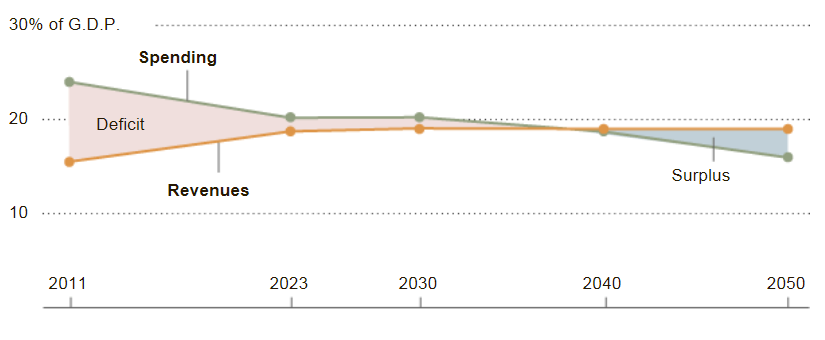
Based on information from Congressional Budget Office and the House Budget Committee, the Times put together a chart about his plan:

image

In addition, the Times reported that the budget (highlighting be me):

Would set a cap on discretionary spending for fiscal year 2013 at $1.028 trillion, which is $19 billion lower than the cap established by the Budget Control Act in August 2011.

Would allow the military budget to grow with inflation over the 10-year period.

Would repeal President Obama's health care law, and like last year's proposal, transform Medicaid into a block grant to the states. Medicare would be changed to offer a menu of subsidized private insurance plans.

Balance the budget? by 2040

New revenues? No

Debt reduction: From 68% of G.D.P. in 2011 to 10% in 2050

For individuals, would eliminate deductions and credits and create just two income tax rates, 10 and 25 percent. Would reduce the top corporate income tax rate to 25 percent from 35 percent.

Paul Krugman, the Pulitzer Prize-winning Economist, wrote about Ryan in his New York Times column:

So why have so many in Washington, especially in the news media, been taken in by this flimflam? It's not just inability to do the math, although that's part of it. There's also the unwillingness of self-styled centrists to face up to the realities of the modern Republican Party; they want to pretend, in the teeth of overwhelming evidence, that there are still people in the G.O.P. making sense. And last but not least, there's deference to power -- the G.O.P. is a resurgent political force, so one mustn't point out that its intellectual heroes have no clothes.

But they don't. The Ryan plan is a fraud that makes no useful contribution to the debate over America's fiscal future.

As the media chewed over what Romney's choice in Ryan meant -- mostly pointing out the controversial points in Ryan's budget -- his campaign seems to have gotten a little nervous. They sent out talking points today distancing Romney from his comments and Ryan's budget.

1) Does this mean Mitt Romney is adopting the Paul Ryan plan?

Gov. Romney applauds Paul Ryan for going in the right direction with his budget, and as president he will be putting together his own plan for cutting the deficit and putting the budget on a path to balance.

Who did Romney think he was getting when chose Ryan? I think there are several reasons why Ryan is a good choice for Romney, but Ryan's budget isn't one of them (unless you're a Tea Party member who thinks it's all about spending and the deficit). For Romney to back away this quickly seems like a serious misstep.

After this backpedaling from his most important choice thus far as presidential candidate, I'm really starting to wonder who's advising Romney.

Labels: ,

posted by AndyO @ 8:21 PM   0 comments

Wednesday, June 06, 2012

Seattle shootings: When violence comes to your neighborhood

The news arrived in an instant message from my brother at work. I'd just returned from lunch and was getting ready to dive back into a massive project.

Erik [1:01 PM]:

Did you see that <my son's school> is/was on lockdown?

Andy [1:01 PM]:

No.

Erik [1:01 PM]:

http://abcnews.go.com/US/killed-injured-seattle-cafe-shooting/story?id=16459770

Andy [1:01 PM]:

Shit.

In less than a minute, the world seemed to turn upside down. My heart raced. According to the report, someone had opened fire and killed multiple people in a cafe in the University District. A woman downtown had also been killed during a carjacking. Police didn't know if the incidents were related.

I knew if schools were on lockdown, then the shooting was close by. I looked up the name of the cafe where the shootings happened, Cafe Racer, and realized I'd parked in front of it many times on my way to Trading Musician.

It's a mile and a half from my house.

I knew there was nothing I could do, so I sent a message to my wife to make sure she knew about it (especially since she was picking up our son from the locked down school). 

Trying to make sense

After I got home and started to read about the incident, the sadness started to set in. This guy had killed five people. The woman who died in the carjacking in downtown Seattle -- over five miles away from Cafe Racer -- was one of the victims. 

I watched people on Facebook trying to make sense of the brutality. My fellow bandmate, Chris, wrote:

OMG, what is happening here. I have stopped in Cafe Racer for espressos in the a.m. many times, and for drinks with Mary in the p.m. once in a while. What? Completely peaceful, funky U-District dive bar, until...senseless gun violence! Sad, sad...

The media pounced on the statistic that there were 21 homicides in Seattle in 2012, more than all of 2011. (The 10-year homicide average from 2000-2010 is 26 per year.)

Then I saw that the shooter himself, identified later as Ian Stawicki -- who had shot himself as police closed in -- had died at Harborview.

Later, I read a thoughtful article on Time.com called Seattle Shootings: Six People Dead in One Day. What�s Behind the Violence? It explored how an event like this affects children at the schools and their parents who are left to explain what happened. As my son told me, the teachers and other school officials don't give any details. The kids don't even know if it's a real event or another drill, which kind of makes sense. My son said, "They don't tell us anything, because some people freak out."

At my son's school, he said they spent an hour on the floor and then after that could walk around inside the classroom. But they stayed in the same classroom until they were released from school, three hours later.

As I've gotten older, I've started to realize that violence like this happens. You just hope that it's not going to happen to you. Which is why this event is different: When this kind of shooting occurs a mile or so away from your house, it all of sudden becomes less of an abstraction. I've stopped in front of Caf� Racer; I could have been standing there when the gunman came out.

There have been other incidents in Seattle recently with people being killed or injured with stray bullets, which makes it even more apparent how little we're all in control. 

Aftermath

As the memorial piled up in front of Cafe Racer, the citizens of Seattle continued to try and make sense of what happened. Details came out about Stawicki from his family about how the clues were there. Details came out from a hero at the scene who attacked Stawicki with barstools and probably saved three people's lives.

But there are two major parts to this story:

First, Stawicki was suffering from mental illness and a history of violence (in some cases, the violence was against his own family). His father talked about how he would have needed to lie to commit his son to an institution against his will.

Second, guns are too easy to buy and conceal in Washington State, where the  laws just aren't set up to prevent someone like Stawicki from getting guns. (More on that later.)

What we know now is Stawicki legally obtained "six .45-caliber or 9-mm handguns since 1993, including .45-caliber handguns in 2006 and 2008 from Lynnwood and Bothell gun shops," according to this Seattle Times article. The problem is there were no red flags that would have prevented Stawicki from buying guns; he didn't have a felony record or had never been committed to a mental hospital.

In 2008, he started getting in trouble, including four domestic violence-related misdemeanors against his girlfriend, who later recanted. Then, against his own brother (this time his mother changed her story).

I'm not blaming the Stawicki family from protecting their son against going to prison, or even the girlfriend (who might have feared for her life). But it seems like if someone starts showing signs of rage and mental illness, then that person should no longer be able to possess a gun -- or in Stawicki's case, six guns. And if he's caught with a gun on him, the punishment is severe.

Stawicki was completely within the law to have guns on him when he entered Cafe Racer. It was only when he opened fire that it became illegal.

Three ideas

So, what can we do, citizens of Seattle, Washington State, and the United States? Here are my ideas. I'm sure there are many more great ideas out there.

1. Make it easier for a person with mental illness to get help -- either voluntarily or involuntarily. Mental illness is something that can be treated and needs to be treated. Washington State's recent mental health parity laws have helped, but more needs to be done. Cutting budgets from mental health organizations is only going to make this worse.

2. Make it much harder for certain people to get a gun (or guns) and get a concealed weapons permit. Not only did Stawicki buy six guns, but he also had a concealed weapons permit. According to what I've read, the police had to issue Stawicki a permit, since he met the standards -- even if the police knew he was dangerous.

I've heard that lawmakers in Washington State are looking at changing one word to handle cases like this. The word in this sentence would change from "shall" to "may" in the Concealed Pistol License.

(1) The chief of police of a municipality or the sheriff of a county shall within thirty days after the filing of an application of any person, issue a license to such person to carry a pistol concealed on his or her person within this state for five years from date of issue, for the purposes of protection or while engaged in business, sport, or while traveling.

Washington's gun laws are much more permissive than a state like California, according to this LA Times editorial. As the article says:

Unlike Washington, this state has a more restrictive "may issue" standard when it comes to concealed weapons permits. Background checks are more extensive and might involve interviewing an applicant's family, which would have turned up the information that they thought Stawicki was missing several marbles. Some California jurisdictions even require psychological testing for permit applicants. Moreover, Stawicki would have had to demonstrate good cause to carry a concealed weapon -- typically, applicants in California have to show they're under some kind of physical threat, perhaps by someone they've taken out a restraining order against. Being a security guard is also typically considered good cause. Stawicki didn't meet those standards.

Personally, I'd be fine with abolishing all guns. Since I know that's not going to happen, can we at least make it harder for people who shouldn't be able to carry them? 

3. Teach compassion from a young age. When His Holiness the 14th Dalai Lama of Tibet came to Seattle a few years ago, his message was about compassion and it really resonated with me. Here's part of an essay he wrote about this and it gets at the heart of how this can change things.

Whether people are beautiful and friendly or unattractive and disruptive, ultimately they are human beings, just like oneself. Like oneself, they want happiness and do not want suffering. Furthermore, their right to overcome suffering and be happy is equal to one's own. Now, when you recognize that all beings are equal in both their desire for happiness and their right to obtain it, you automatically feel empathy and closeness for them. Through accustoming your mind to this sense of universal altruism, you develop a feeling of responsibility for others: the wish to help them actively overcome their problems. Nor is this wish selective; it applies equally to all. As long as they are human beings experiencing pleasure and pain just as you do, there is no logical basis to discriminate between them or to alter your concern for them if they behave negatively.

People who are compassionate are less likely to hurt or bully others. Was there a point in the past when an act of compassion or kindness could have changed Stawicki's course? We'll never know. It sounds like his family tried to help and ran out of options. You can only deal with rage for so long, and no one wants to believe that a family member or friend could do something like this.

Labels: , ,

posted by AndyO @ 9:40 PM   0 comments

Sunday, April 08, 2012

The Exorcist: The first blockbuster horror film

The Exorcist raised the bar on horror films, creating a truly terrifying story that's still scary today. The Exorcist brought a realistic approach to horror that hadn't been seen before, and was the first horror blockbuster, grossing (US) $232,906,145 in the U.S. If you adjust the gross in today's dollars (2012), it would be (US) $865,991,500 (the 9th highest U.S. domestic gross).

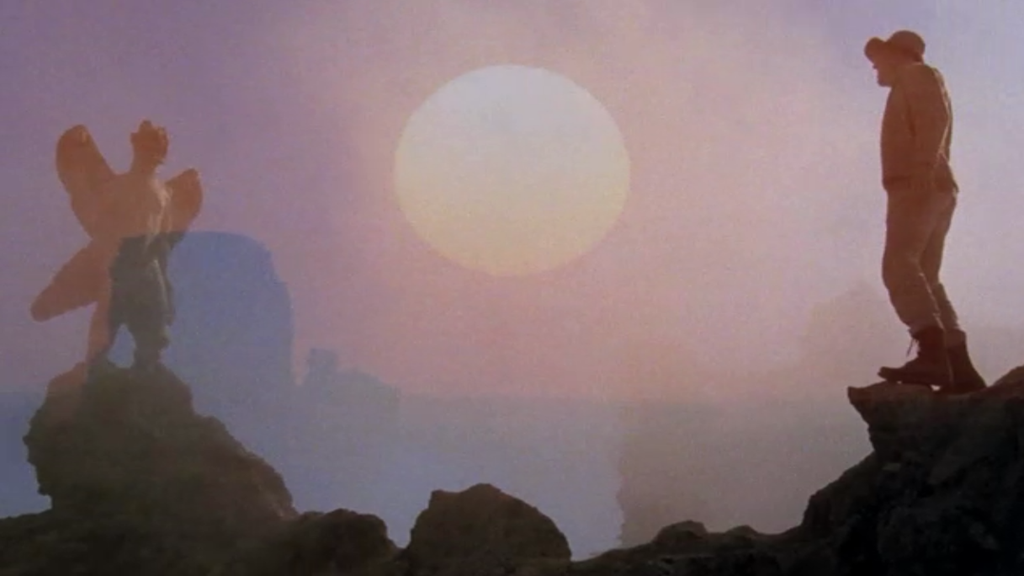
Opening image from "The Exorcist"

While The Exorcist didn't win the Oscar for Best Picture in 1973, it did win for Adapted Screenplay and Best Sound. It was nominated for a total 10 awards.

The other films nominated for the Best Picture Oscar in 1973 included:

  • The Sting (Winner)
  • American Graffiti
  • Cries and Whispers
  • The Exorcist
  • A Touch of Class

For the Golden Globes, The Exorcist was nominated for seven awards and won four awards, including Best Picture.

The cinematic and cultural influence of The Exorcist

The Exorcist's influence has only grown since its release, as polls frequently rank it among the scariest films of all time. While it hasn't been added to the AFI's top 100 films, it has made the "AFI's 100 Years ... 100 Thrills" list, coming in at #3. To see the effect of The Exorcist on other films and TV, see this IMDB Movie Connections page for The Exorcist.

Perhaps it's understandable why the Academy was wary of voting for The Exorcist. First and foremost, horror films didn't win Best Picture. And then there was all the hysteria and hype around the film. 

Father Lankester Merrin encounters the demon Pazuzu statue in Iraq

In L. Vincent Poupard's excellent article, "The Cultural Impact of the Exorcist," he writes of what happened when the film was released:

When The Exorcist came out, a strange occurrence happened across the country. For the first time in years, churches all over became packed. There were tens of thousands of people that were so affected by what they had seen in The Exorcist that they needed some kind of guidance to comprehend and understand what they had seen. Many people turned to the Church for guidance.

Evil vs. Good in Iraq

In John W. Whitehead's article, "Who's Afraid of The Exorcist?" he writes of how the film was released at a crucial time when many people were questioning the existence of God:

The Exorcist captured the critical questions of its time: Is God merely the delusion of a handful of prophets and gurus? Is Satan personified evil? Made against the backdrop of the Sharon Tate massacre and the chaotic events of the late 1960s, the film examined what happens when the insanity of evil and violence mash up against the soul. In a sense, with the triumph of the spirit, The Exorcist signalled the end of the death-of-God movement.

It's not often that a film has this kind of impact in society. 

One of the final shots

Labels: ,

posted by AndyO @ 11:28 AM   0 comments

Saturday, March 31, 2012

Bouncy House safety rules

I went to a BBQ today with my colleagues from work and their families. Of course, a BBQ in Seattle before May or June means you might be inside due to rain (which we were).

The hosts of the BBQ rented a bouncy house for all the kids, which was awesome. Even with the wet weather, kids ventured into the bouncy house to burn off energy. As Drew was inside jumping, I happened look at the safety rules for the bouncy house. Here's what I saw:

WP_001352 

Basically, if you get hurt it's your own fault -- and don't even think of suing us. My favorite is "No unevenly matched players."

The thing you can't see is the caution about operating the bouncy house on a wet surface -- because, you know, you could get electrocuted. I guess the bouncy house company ignored that one.

These rules reminded me of a sign I once saw on Maui in 2011 that not only warns you of all the dangers in the ocean -- but absolves the surrounding businesses of any legal action. If you die, don't say we didn't tell you to be careful.

IMG_0041

Labels: ,

posted by AndyO @ 7:41 PM   0 comments

Monday, December 26, 2011

Gazelle and Beezid: Getting a good deal or getting ripped off?

Recently, I'd heard about two businesses that sounded really interesting:

  • Gazelle - Pays you money for your old gadgets. They send you a box and you send your old electronics for cash (or a gift certificate).
  • Beezid - Bid on items and (hopefully) get them for a huge discount.

These sound pretty good at first. But when you dig deeper, both of these come up short, at least for my purposes.

Gazelle

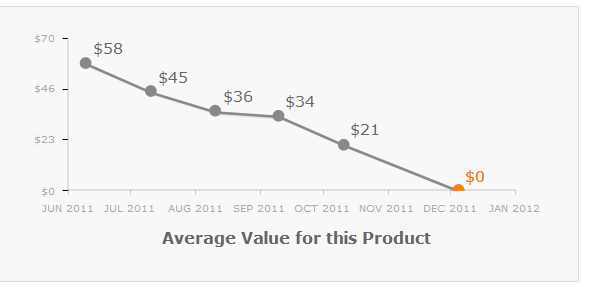
Everyone has old electronics sitting around the house. I actually have an old Xbox 360 Elite. I plugged this in at Gazelle to see what I could get, and here's the chart that came up:

image

Clicking through to the end, I saw this:

Unfortunately, we can't offer you any money for this item

Even though we can't pay you, we'd still like to help you recycle it responsibly. It's easy. Just click the 'recycle' button to add it to your box. As long as something else in your box has value, we'll still pay for shipping.

That's really nice that they're willing to send me a box to recycle it, but I still have to pay for shipping (unless I'm sending something else of value).

After getting offers of $0.00 for a few items I searched on, I plugged in my wife's brand-new Kindle Fire (which I bought for $199.00) and got the following offer:

image

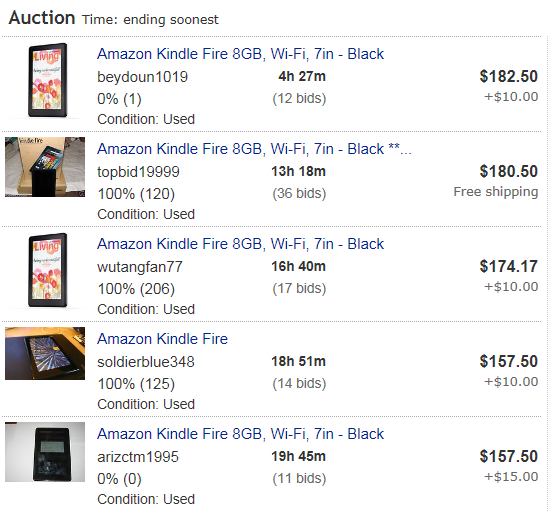
So, I checked out eBay, and Kindle Fire's are listed for around $180 (although I'm not sure they all sell for this). The point is, I would expect a Fire to go for at least $120.

image

After browsing through Gazelle, it wasn't clear how I could ever get a fair price for anything in my garage. In most cases, I got no price. And the ever-so-helpful "we'd like to help you recycle it responsibly" message is exploitation masquerading as concern: Send us your stuff (and you pay for shipping), and we'll then "recycle" it for you. Yes, they might actually recycle your electronics -- but I don't think they'd be recycling anything because it's the right thing to do. This is most likely how they make most of their money.

Go to SiteJabber.com for more information from other people about Gazelle.

Beezid

I'd heard about Beezid being a place you can save up to 99% on auctions. Sounds pretty great, doesn't it? Here's what some of the auctions look like (what they call Live Penny Auctions):

image

Given that this looked a little too good to be true, I checked out how you bid for items on Beezid. Here's what I found on their FAQ site:

We offer several bid packages tailored to meet your needs. The cost for each bid will vary based on the package you choose. Bids are available in packs of 30, 50, 100, 200, 500 and 1000 and range from $0.55 - $0.90 per bid. The more bids you buy, the cheaper it gets for each bid, and the greater the savings you can enjoy! Get yourself a Bid Pack and jump into the savings!

Wait a minute -- you need to pay between $0.55 and $0.90 per bid, even if you don't win anything? That sounds similar to another type of business: video slot machines at casinos. In this case, Beezid makes their money from all the bids that people put in. There's one "winner," who gets a great deal on an iPad, but everyone else loses.

I'm wondering how something like this could be legal? I mean, didn't the government shut down all the online poker for money sites in 2006? Actually, they did. But then United States Department of Justice just reversed this decision. (I just found this out while writing this article.)

OK, back to Beezid: If you like to pay for the privilege of bidding on an item, then this site's for you. But I'm of the belief that you can't get something for nothing. Even if you do get an item for free or cheap somewhere, think of all the time it took to get that item. This is why eBay's never worked for me -- I don't have the time or patience to watch auctions. I admire people who do have this ability, but it's not for me.

As to whether Beezid is a scam or a good deal, SiteJabber seems to agree with me that it's a scam.

Labels: , , ,

posted by AndyO @ 7:32 PM   0 comments

Sunday, October 30, 2011

How to start fixing our financial and political mess

I just read a great New York Times editorial by Thomas Friedman about the current financial and political mess in the United States. Here's the part that everyone should read about how to start repairing the damage (#4 highlighting added by me):

Our Congress today is a forum for legalized bribery. One consumer group using information from Opensecrets.org calculates that the financial services industry, including real estate, spent $2.3 billion on federal campaign contributions from 1990 to 2010, which was more than the health care, energy, defense, agriculture and transportation industries combined. Why are there 61 members on the House Committee on Financial Services? So many congressmen want to be in a position to sell votes to Wall Street.

We can't afford this any longer. We need to focus on four reforms that don't require new bureaucracies to implement. 1) If a bank is too big to fail, it is too big and needs to be broken up. We can't risk another trillion-dollar bailout. 2) If your bank's deposits are federally insured by U.S. taxpayers, you can't do any proprietary trading with those deposits -- period. 3) Derivatives have to be traded on transparent exchanges where we can see if another A.I.G. is building up enormous risk. 4) Finally, an idea from the blogosphere: U.S. congressmen should have to dress like Nascar drivers and wear the logos of all the banks, investment banks, insurance companies and real estate firms that they're taking money from. The public needs to know.

Capitalism and free markets are the best engines for generating growth and relieving poverty -- provided they are balanced with meaningful transparency, regulation and oversight. We lost that balance in the last decade. If we don't get it back -- and there is now a tidal wave of money resisting that -- we will have another crisis. And, if that happens, the cry for justice could turn ugly. Free advice to the financial services industry: Stick to being bulls. Stop being pigs.

Did You Hear the One About the Bankers? - NYTimes.com

Labels: ,

posted by AndyO @ 11:16 AM   0 comments

Saturday, March 06, 2010

My list of best Seattle breakfast restaurants

I recently updated my list of best breakfast restaurants in Seattle. Let me know if you have any favorite breakfast spots I should check out.

List of Best Breakfast Restaurants in Seattle

Labels: , , ,

posted by AndyO @ 10:50 AM   0 comments

Saturday, February 27, 2010

My list of best Washington State movie theaters

I recently updated my list of best movie theaters in Washington State. Let me know if you have any favorite theaters I should check out.

List of Best Theaters in Washington State

Labels: , , , ,

posted by AndyO @ 10:56 AM   0 comments

Monday, February 22, 2010

NBC's Olympic Coverage: Bad

As I've skipped through my DVR recordings of the Olympics, I've come to realize that I'm disappointed in most of NBC's coverage of the games.

Sure, there are some interesting special effects, like showing the "ghost" of one skier racing against another, or the moving line a skater has to beat to take home the gold medal; but for the most part, it's bad sports journalism that feels like a reality TV show.

This New York Times article gets at what's wrong with NBC's coverage:

Cheering Team USA on NBC's Olympics

Labels:

posted by AndyO @ 12:16 AM   0 comments

Saturday, January 23, 2010

ARCO's ATM is anything but convenient

On Thursday, on my way to get car tabs, I stopped at an ARCO gas station to get gas and cash. I pulled up to the pump and inserted my debit card into the ATM. Of course, there was a 45-cent convenience fee (actually not bad for a cash machine).

phone 033

After I started pumping gas, I examined the ATM a little more; it soon became clear that there wasn't an option to get any cash from this machine. I was paying 45-cents for the convenience of using ARCO's gas pump, which is odd because Shell and Chevron don't charge extra fees for using their gas pump. 

I felt a little swindled by ARCO. I think most people would agree that an ATM should include the ability to spit out some cash. Even if you pay with a debit card at Safeway or 7-11, there's usually an option to get back some cash. And they don't charge you a convenience fee.

What does ARCO have to say about this? Here's their website, which says this about how convenient their gas stations are:

Straight up convenience.

You can pay on the gas island with cash or your ATM card using PayQuick, It�s an easy way to purchase at the pump to get in, out and on your way quickly.

To avoid the 45-cent convenience fee, use your ARCO Debit MasterCard. Plus you can earn reward points when you use it!

Because I was in a hurry (and I needed cash for the emissions test you have to get in Washington state), I went inside to see if they had a real ATM. They did, but now they wanted $2.00 for the convenience of withdrawing cash.

I don't know about you, but I don't find $2.00 in fees very convenient. Which is why I won't be visiting ARCO again anytime soon. I also recommend that ARCO change the language on their pumps to be more accurate. For example:

Pay with cash or debit card

The worst part was that I did pay the $2.00 convenience fee at the real ATM, because I was in a hurry. I know that ARCO was counting on this, but you would think they'd be interested in forming a long-term relationship with me so I'd be willing to return to their store and buy snacks -- because that's where the real profit is.

Labels: ,

posted by AndyO @ 4:49 PM   4 comments

Saturday, September 19, 2009

IMAX 3-D digital films: Upsell illusion

I just went to see Cloudy with a Chance of Meatballs with the kids today at the Regal Thornton Place theater in IMAX 3-D digital. The total cost for the matinee show (11:40 am) was $40.50! That's $15.50 for me (instead of the usual $8.50 matinee price) and $12.50 for each kid.

Stepping into the IMAX auditorium eased my buyer's remorse somewhat. The screen reaches from floor to ceiling and wall to wall -- not as big as the curved Boeing IMAX theater at Seattle Center, but certainly bigger than the average screen.

When the film started, the sound system thundered like a freight train, and the image quality was sharp and vibrant. But then I noticed something that I'd noticed in two other IMAX films, Up and Night at the Museum 2:

The image didn't fill the entire screen.

Much like watching a 16:9 widescreen movie on a TV, there were black "bars" across the bottom and the top of the screen:

image

So, how is this much different than a regular movie image? Why am I paying almost twice as much just because the screen is large?

After doing a little research, I found that a firestorm erupted in May 2009 by actor/comedian Aziz Ansari after he saw the new Star Trek movie on a screen that he didn't consider to be of proper IMAX size. (Turns out, most people think this is around 72 feet high.)

According to IMAX CEO Rich Gelfond in a Wired article, the screen size isn't the only thing that makes IMAX what it is:

IMAX means the most immersive film experience on the planet. 3-D is going to be more obvious to you in IMAX. And in 2-D, IMAX means a special sound system. It means special treatment of the film so that when Star Trek is shown in an IMAX theater, it goes through a digital process where we up-res the movie so there's more brightness and more contrast.

And with the screen part of it: In all of these multiplexes, IMAX is the biggest screen. But it's not only screen size. There's something called "perceived screen size," which involves the relationship of the viewer to the screen. If you're in the first row, that screen is going to look a hell of a lot bigger to you than if you're in the 30th row. We typically take out the first four rows of seats in a theater and move the screen forward so it's a lot farther forward in an IMAX theater. Also, the screen goes floor to ceiling, wall to wall. By bringing a floor-to-ceiling, wall-to-wall screen forward toward the audience, the viewer has the perception that the screen is larger than just the physical size.

I buy that there's a different process for converting a film for IMAX and that the sound system is better. But my beef is that the screen size is large but the movie isn't filling that screen. Well, then, I must be seeing a much better image resolution.

It turns out the image resolution might be only slightly better.

The IMAX digital film is created by using two Christie 2K resolution digital projectors. According to Wikipedia, "the two 2K images are projected over each other, producing an image that is potentially of a slightly higher resolution than common 2K digital cinema."

So, if the screen isn't larger, then you're not really getting much value for your expensive ticket -- just an image that is potentially of a slightly higher resolution. But I thought the reason for paying for an IMAX version of the film is so you can have the most immersive, amazing experience in a movie theater. Turns out it's not much different than going to the non-IMAX or 2D version of the film -- at least in some theaters.

Then what's going on here? Like many things in life, it's about money.

Let's take a look at The Dark Knight. $55 million of the $1 billion the film earned worldwide (18%) was from IMAX theaters. Without those "premium" tickets, the film takes in less money, the studio execs get smaller bonuses, the theater chains can't add more IMAX theaters, etc.

But the real crime with the smaller IMAX screens or the reduced projection size on a large screen is that the average moviegoer isn't even aware (at least consciously). They're paying extra for the IMAX brand -- and not really getting their money's worth.

So, as I see it IMAX has three problems (and to their credit, they're looking into fixing the branding problem now):

  1. Not all IMAX screens are equal in size.
  2. Not all IMAX screens are equal in resolution (digital vs. 70mm).
  3. The projection image size of the IMAX film doesn't always take up the entire screen size -- which brings us back to #1.

If you want to know which IMAX screens are the smaller size, here's a handy map:


View IMAX or LIEMAX? in a larger map

If you're interested in reading some other articles about this issue, see the following:

Roger Ebert's Q&A on IMAX (published before Aziz Ansari's blog)

LFexaminer: Is IMAX the next "New Coke"?

LFexaminer: Links to IMAX controversy articles

Variety: IMAX responds to screen size critics

Labels: , , ,

posted by AndyO @ 11:41 PM   1 comments

Monday, July 20, 2009

Thoughts on the 40th Anniversary of Apollo 11

It was 40 years ago today, when I was just 2 years old, that Neil Armstrong and Buzz Aldrin landed on the moon. This was, arguably, the greatest technical achievement of the human race. And every year since that historic event, we seem to grow farther away from what was accomplished in 1969. Instead of new manned missions beyond the moon -- or even a base -- we get conspiracy theorists telling us we never even went to moon.

I can only hope that with Project Orion we start to move forward again with manned deep space exploration. While I'd like to see us go to the Moon again, it seems like a bit of a step backward. If we said we were going to the Moon again to set up a base there, then it starts to make more sense. But everyone knows the next real objective is Mars. There's a  scientific reason to go there.

They say after the Apollo missions, the people of Earth turned inward again (there wasn't an environmental movement until those pictures of Earth were taken by the astronauts). Perhaps what we really need is to turn outward again -- to explore. Perhaps this would change us as a species in ways we can't even imagine.

I hope so.

Labels:

posted by AndyO @ 11:55 PM   0 comments